
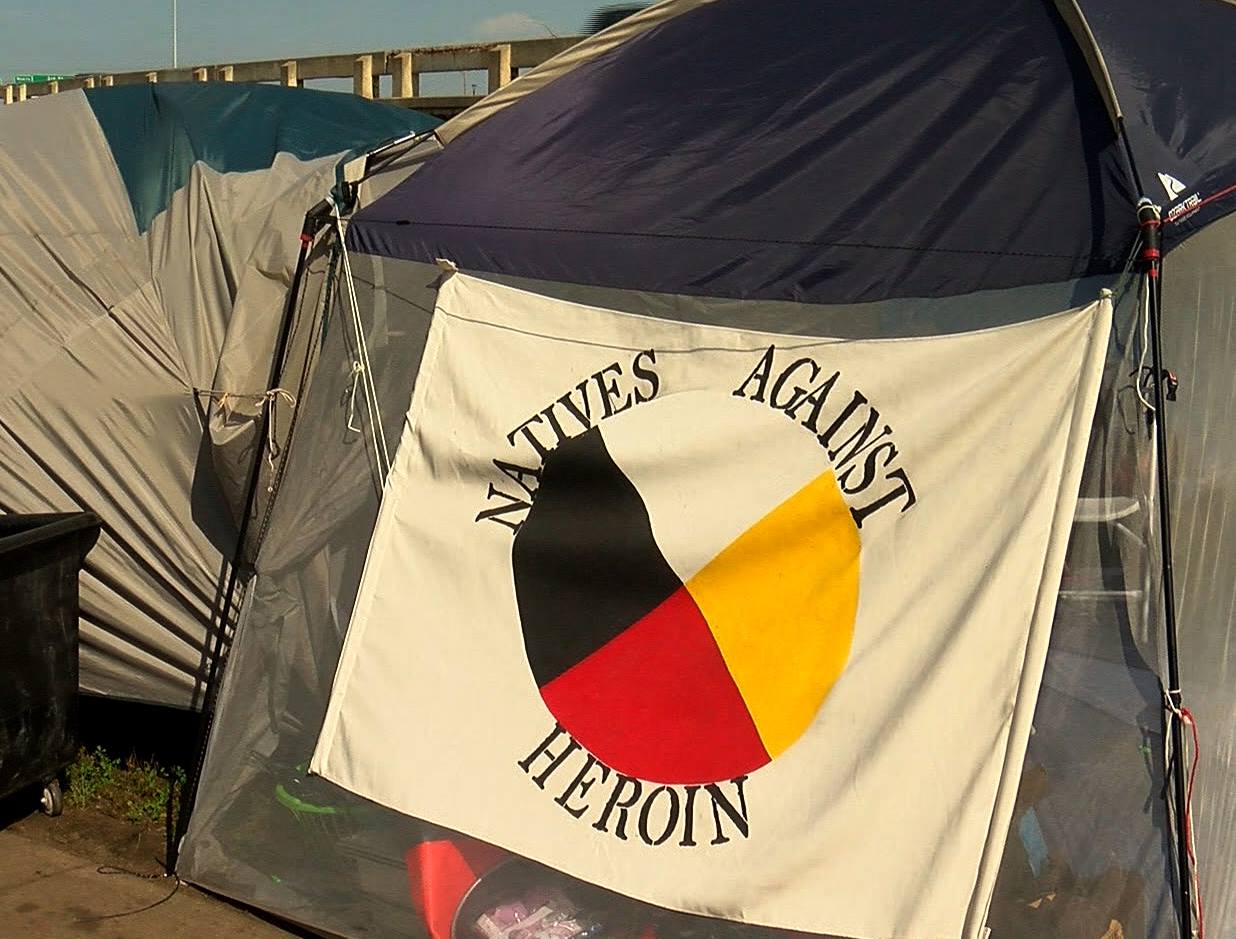
This week on Minnesota Native News, we get an update on the Minneapolis homeless encampment, also known as “the wall of forgotten natives.” We also hear about a new police agreement between the Mille Lacs band of Ojibwe and the county sheriff’s office that ends a two-year impasse.
Transcript
MARIE ROCK: This week on Minnesota Native News, we get an update on the Minneapolis homeless encampment, also known as “the wall of forgotten natives.” We also hear about a new police agreement between the Mille Lacs band of Ojibwe and the county sheriff’s office that ends a two-year impasse.
Here’s reporter Cole Premo.
MAGGIE THUNDERHAWK:“I really been homeless for a long time. I just got here like maybe a month ago.”
(That’s Maggie Thunderhawk)
JAI-PHOENYX: “I'm transgender and I moved here a little over a year ago to Minneapolis”
(And Jai-Phoenix)
JAI-PHOENYX: “For me personally, it's been a little rough, you know, especially just being new here at first I'm just being a mostly white.
MAGGIE THUNDERHAWK: “It's better. Yeah. Because, um, where, where wherever we went we either got chased away from that spot or to call cops were called on us because we couldn't be there.
JAI-PHOENYX: People warmed up to me and I got pretty close to a lot of people and it kinda feels like family now, which is good and I'm getting a lot of help. And actually just today got my referral for housing.
MAGGIE THUNDERHAWK: You get a lot of services here. I signed up for housing.
As fall sets in and with winter just around the corner, Jai and Maggie are just two amongst hundreds livings at the Minneapolis homeless encampment on Hiawatha Avenue.
Nicknamed “the wall of forgotten natives”, the nonetheless diverse camp has been expanding for months. And the options are limited for moving the camp to a preferred spot for all parties involved, and it’s all happening within a shrinking timeline.
The Minneapolis City Council recently delayed their final vote to choose between two options… a parking lot on 2600 Minnehaha, which is a controversial location due to it being near two charter schools with young students, or the Roof Depot location, which would require millions of dollars to prepare.
Meanwhile back at the camp, outreach groups have been assisting the camp with food, shelter and services.
JAI PHOENYX: “There's a lot of community here, especially now with the Natives Against Heroin tent.”
As the name Natives Against Herion implies, a big problem at the camp is addiction.
JAMES CROSS: “we do confront them in a good way. Uh, we let them know that we don't want them here” … “we don't need it in this community and you want it because we got elders, we've got kids, we've got the whole life cycle in there.”
James Cross, founder of Natives Against Heroin, says he’s been out here working at the camp since day one and considers himself the camp spokesperson.
JAMES CROSS: “Securing it, desescalating it and negative behaviors. Doing ODs, saving lives. 10:29 Make sure there's coffee cigarettes and something to eat every morning so we can wake up in a good day so that they know that natives against heroin hasn't forgotten about our people.
Cross, a former addict and gang member who has lived though homelessness, says the camp has been a long time coming. Building a closer knit community has provided help for addicts and families alike.
JAMES CROSS: Before it was all silo organization, Silo programs, silo, everything. And at this time it's bringing everybody together.
But there is still the need of where to move the camp for the winter, which is brutal in Minnesota. It’s current location is not ideal for those types of conditions.
But the camp needs to find a better place for the winter, which is of course brutal in Minnesota. The current location isn’t ideal for blizzard and extreme cold-types of conditions.
According to recent news reports, Red Lake Nation recently proposed moving the camp to a location on nearby Cedar Avenue owned by the tribe. Minneapolis Mayor Jacob Frey said it’s a viable option. The only catch is that demolition of the buildings would need to begin soon in order to get the camp moved there within six weeks.
Whichever location is chosen, Cross says the biggest change needed isn’t to move these people into another camp, or navigation center, but into stable housing free of addiction.
CROSS: “Get these people somewhere where they can better themselves, better people and better the community and start living in a good way. The good life.”
With the mayor vocalizing his support for action, the Minneapolis City Council will meet soon to decide the location.
In other news...
[SOUND OF COUNTY BOARD HEARING]
The Mille Lacs Band of Ojibwe and the Mille Lacs County Sheriff’s Office have a new policing agreement.
Full disclosure, I am a member of the Mille Lacs Band of Ojibwe, but am reporting this without bias.
The agreement, which took effect on September 18th, is a resolution to a two-year impasse that began after the county voted to terminate 25 years of cooperation with the tribal police. It again allows the Mille Lacs band to resume state law enforcement activities.
Mille Lacs County Sheriff Brent Lindgren said at a recent county board meeting that the agreement is a result of many difficult decisions and compromises from the band and county.
“I now look forward to implementing this new Mutual Aid/Cooperative Agreement over my few remaining months as Sheriff,” he said.
The band’s chief executive, Melanie Benjamin, released a statement, saying the past two years have been tragic and difficult years on the Mille Lacs Reservation and that the new agreement is the beginning of a long journey in restoring law, order and hope in our community. She ends by saying the journey will take many years.
The policing agreement does not have any effect on a federal lawsuit filed by the Mille Lacs band arguing reservation boundaries.
This is Cole Premo.