
This week on Minnesota Native News we hear about a big boost to a handful of organizations working with Native communities. We also hear about a new book from Cheryl Minnema [MIN-eh-muh] and a new exhibit featuring Ponca artist Julie Buffalohead.
Transcript
HEADLINES: This week on Minnesota Native News we hear about a big boost to a handful of organizations working with Native communities. We also hear about a new book from Cheryl Minnema [MIN-eh-muh] and a new exhibit featuring Ponca artist Julie Buffalohead.
STORY #1 - BUSH PRIZE FOR COMMUNITY INNOVATION
The Minnesota Based Bush Foundation has announced the winners of its 2019 Bush Prize for Community Innovation.Three of the five winning organizations work specifically with Native people and tribes.
The Minnesota American Indian Women’s Resource Center has been awarded 500-thousand dollars for their work in Minneapolis.
408-thousand dollars went to the Rural Renewable Energy Alliance for its work building affordable renewable energy systems with tribal communities in the northland.
And South Dakota State University was awarded 500-thousand dollars for its initiatiave to transform the campus to be more welcoming and supportive of Native students.
Bush Foundation President Jennifer Ford Reedy says the Bush Prize winners exhibit remarkable creativity and tenacity in addressing issues that are most important to their communities.
STORY #2 NEW BOOK FROM CHERYL MINNEMA
Next… Mille Lacs Band of Ojibwe member Cheryl Minnema [MIN-eh-muh] published her first childrens book in 2014. And her second children’s book is out now. Reporter Melissa Townsend talked with her about her new work.
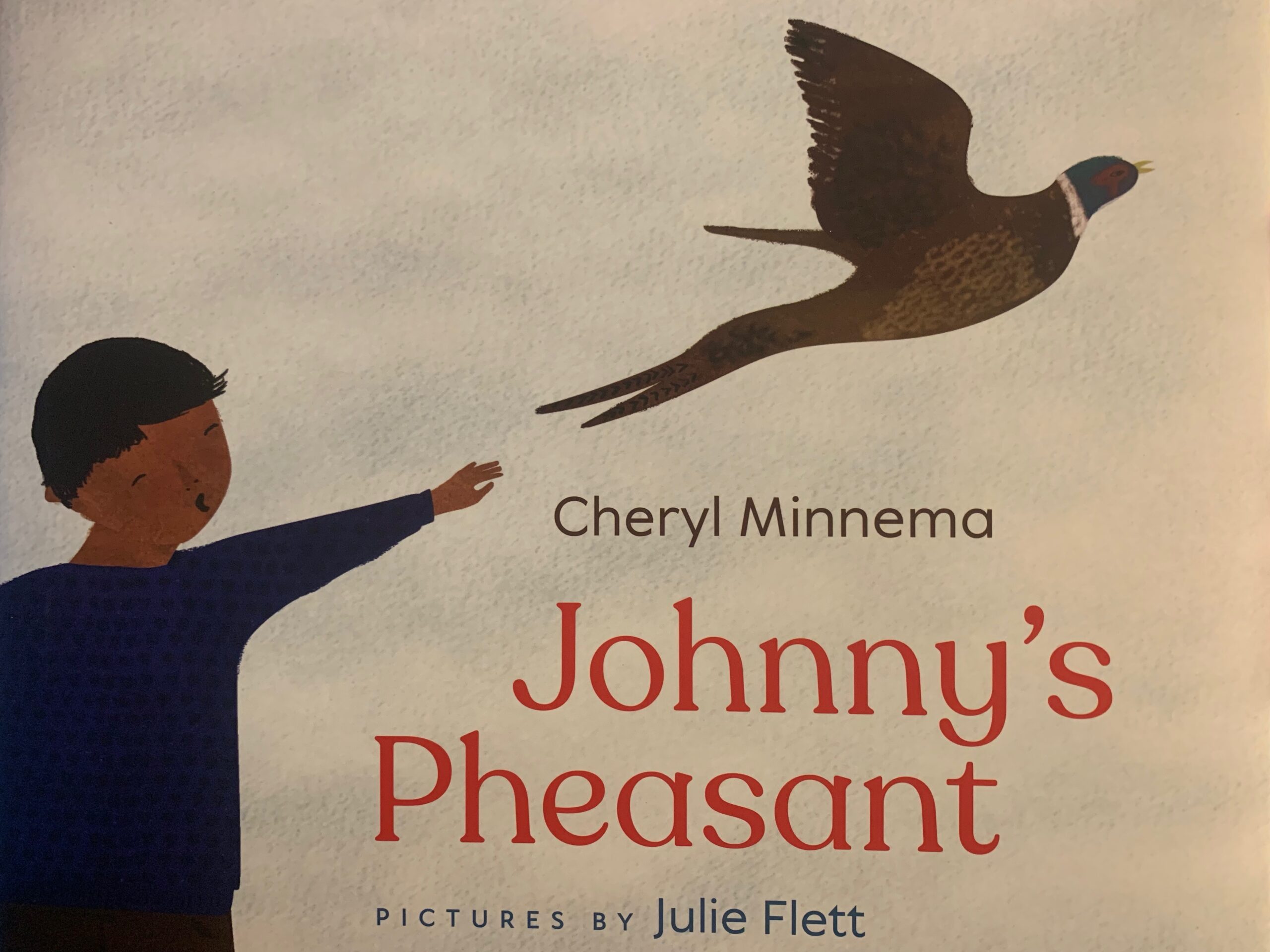
Cheryl Minnema grew up around her Grandmother and her younger brother Johnny in northern Minnesota. And they are both the central characters in her books — Hungry Johnny and Johnny’s Pheasant.
MINNEMA: Yes, Grandma and Johnny are very impressionable people in my life. It’s easy to draw from those memories.
Her brother Johnny passed away a number of years ago but he comes to mind often.
CHERYL: Sometimes I set out to write a particular story that I have in my mind. And then I realize I hear Johnny’s voice in it. (:10)
Cheryl Minnema’s newest book - Johnny’s Pheasant - is an elegantly simple story. She purposefully doesn’t do a lot of explanation or offer a lot of backstory in the book.
MINNEMA: I set out to present situations that are very normal and very natural within the culture. Whether Grandma is visiting or Grandma lives with the nuclear family - it’s just very natural. (:14)
It all starts when Johnny and his Grandma see a pheasant laying motionless on the side of the road. Is he dead or sleeping? You don’t know until the end of the story.
Minnema also writes poetry and it comes through in her writing — like when she describes a feather “zigging and zagging and zigging and zagging ” to the ground.
The story’s Ojibwe Cultural references are clear but also subtle. The Grandmother tells Johnny - if the pheasant is dead - she can use the feathers in her craftwork. And I wonder if this is the only published children’s book where the last lines are “Howah!”
MINNEMA: It’s an expression within the Ojibwe language expression of like Wow, thank you. There is so much in that little word. (:14)
Just like there is so much in this short story. Johnny’s Pheasant is illustrated by Julie Flett who is Cree-Metis and published by the University of Minnesota Press. For Minnesota Native News, I’m Melissa Townsend.
STORY #3 - NEW MIA EXHIBIT OF JULIE BUFFALOHEAD’S WORK
St Paul based artist Julie Buffalohead has a new exhibit opening at the Minneapolis Institute of Art later this month. Buffalohead is a citizen of the Ponca tribe in Oklahoma. This exhibit features 5 new pieces of art - but 3 of them are huge - 12 feet tall and 4 and 1/2 feet long!
YOHE: There is nobody out there doing what Julie does. (:03)
Jill Ahlberg Yohe [YO-hee] co-curated the exhibit with Josephine Lampone, who is Kiowa. Ahlberg says art is a language and Julie Buffalohead is using that language to tell stories about social, political, and personal experiences.
YOHE: Well this incredible work Cages is about being in cages and what that means historically and what that means in contemporary moments (:09)
The work is deep and layered. Animals are often central characters in her work and Buffalohead does not decipher each detail for the viewer.
YOHE: As you know many non-Native people have this urgency to decode it — what does it mean - what does it really mean? What does this symbol mean? [laughs] (:13)
Co-curator Josephine Lampone includes some descriptions of Native animal stories in the exhibit, but viewers are encouraged to do their own thinking. The exhibit opens at MIA in Minneapolis on November 23rd and runs through September 2020.
Co-curater Jill Ahlberg Yohe [YO-hee] says she expects Julie Buffalohead will soon be in high demand internationally.