
This week on Minnesota Native News we hear how the White Earth and Leech Lake Bands of Ojibwe continue their efforts to straighten out a costly mistake involving the state Department of Human Services and billboards in Duluth raise support for missing and murdered indigenous women and people.
Transcript
HEADLINES: This is Minnesota Native News, I’m Marie Rock.
STORY #1 - DHS Overpayments (3:30)
The White Earth and Leech Lake Bands of Ojibwe continue their efforts to straighten out a costly mistake involving the state Department of Human Services.
Reporter Melissa Townsend has the latest on the story.
It was sometime last spring when state Department of Human Services officials realized the state had been overpaying the tribes for their Medically Assisted Treatment programs.
Those are the Suboxone or Bupenorphine programs at Leech Lake and White Earth.
D-H-S says the tribes are required to pay back 23-million dollars
That’s 11-million from White Earth and 12 million from Leech Lake.
DHS and Tribal officials met in June to discuss the problem.
And they met again in July.
In August, the news hit the headlines and a State Senate committee held a hearing on August 13th.
In that hearing - the issue became clearer — sort of.
STEVENS: Thank you Chairwoman Benson and Chairman Abler and community members… (:04)
Dani Stevens is the White Earth Interim Quality Assurance Coordinator. She described how the tribe billed the state for its Suboxone program.
STEVENS: If the patient qualifies for that consolidated funding at the high rate - which is our encounter rate - which goes up every year - but 2019 for example it’s 455 for that encounter rate. (:11)
That’s 455 dollars per visit.
STEVENS: Now if they’re on consolidated funding, don’t qualify for MA but qualify under housing or financial reasons, they’re at a low rate at 61.15. (:13)
That’s 61 dollars and 15 cents per visit.
STEVENS: And we also have people who don’t qualify at all and are over-income and we eat the cost. (:05)
Stevens is describing how the tribe charges different rates based on the patient’s eligibility.
But that’s not how the state talks about it. They say billing is based on the services provided.
DHS says the higher rate is for patients who get Bupenorphine and intensive treatment.
The lower rate is for patients who just take the medication home without seeing a counselor.
So why are there two different versions of how billing should happen? That’s the subject of investigation.
The state is looking into its own handling of the situation.
White Earth officials say they have suspended the Behavioral Health Director while they investigate.
And Leech Lake says they’ve already looked into it. And they’ve reportedly produced all the emails between tribal and DHS officials. They prove the tribe was following the billing instructions they got from the state.
Tribal officials say there will be a serious long term impact on tribal members if they have to find 23-million dollars to give back to the state.
Dani Stevens, White Earth Interim Quality Assurance Coordinator, talked about it at the hearing.
STEVENS: The impact will be far reaching, including loss of jobs, loss of housing, increase of security and safety concerns, increased health concerns and increased child welfare involvement. (:12)
It does seem there is a growing sense that D-H-S is also on the hook and should share the responsibility.
This is State Senator Scott Jensen at the August hearing:
JENSEN: So bottom line is we have a 455 dollar per day or a 61 per day and DHS hasn’t helped you understand which it should be so that you could be doing this without any impugning your integrity is that correct?
STEVENS: There are a lot of grey areas in regards to the manual and in regards to billing.
Leech Lake and White Earth tribal officials are asking for timely and comprehensive consultation to solve this problem.
For Minnesota Native News, I’m Melissa Townsend.
STORY #2 - 1 minute
There’s a new billboard on the corner of Superior and Garfield streets in Duluth.
It’s not an ad for anything — it’s a call to action.
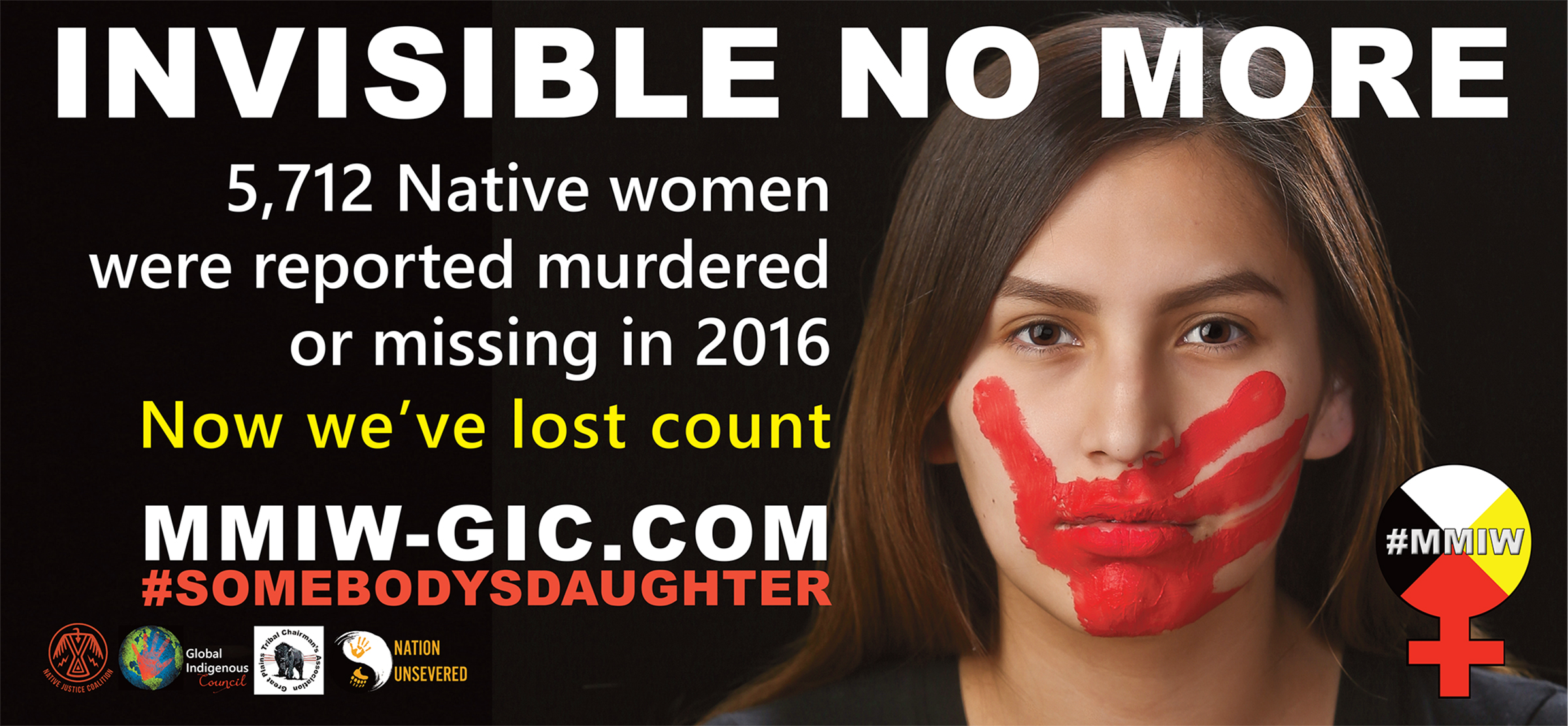
The sign reads “Invisible No More” and says we’ve lost count of the missing and murdered indigenous women and people in Minnesota - and the country.
It’s part of a national billboard campaign by the Global Indigenous Council and Rocky Mountain Tribal Leaders Council to draw attention to the problem.
DeDe Drift is one of the organizers behind the sign.
DEDE DRIFT: Our main purpose is to raise awareness of the need for data and statistics and numbers of missing and murdered indigenous people. (:11)
She also wants to show support for a state-wide task force to address the problem.
De De Drift and her friends Millie Richard [rish- ARD] and Renee Van Nett are organizing a prayer vigil on Sunday, September 15th at the billboard at 3pm.
DRIFT: It’s important that we all come together because we all need to support each other. (:06)
They are also collecting funds to keep the billboard up long term.