
In today’s segment, how new logging orders will affect Minnesota’s natural areas. Wildfire season is upon us. What the experts say you should know to be prepared. And construction is about to begin at one of the most photographed spots in the state,
Transcript
[sound element: NSS intro theme]
HOST: You're listening to North Star Stories: Voices from Where We Live, a daily newscast about what it means to live in Minnesota.
ANCHOR: In today's segment, how new logging orders will affect Minnesota's natural areas. Wildfire season is upon us. What the experts say you should know to be prepared. And, construction is about to begin at one of the most photographed spots in the state. I'm Gracie J.
A new federal order will not include plans for logging in the Boundary Waters Canoe Area. That's according to an official from the US Department of Agriculture. In early April, the Agriculture Secretary announced that logging can begin in more than 1 million acres of formerly protected wilderness areas. The order prompted immediate questions and concerns about the Boundary Waters. The federal administration says the order is to open up public lands in order to reduce dependence on foreign products. But, as of now, it appears the Boundary Waters area is still protected.
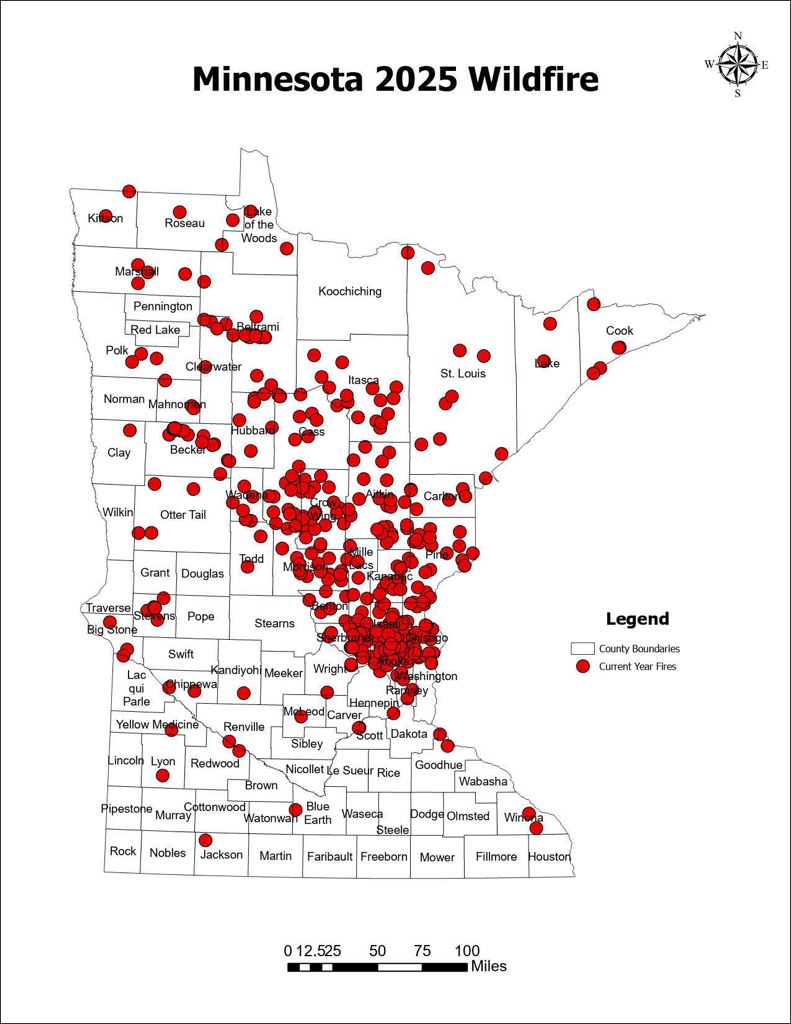
Next, as wildfire season begins in Minnesota, experts urge statewide caution and warn that conditions in the Northeast could make it one of the highest-risk regions in the country. Reporter Maija Hecht has the story.
Karen Harrison
Wildfire behavior is impacted by three things, one is topography, one is weather, and one is fuels.
Maija Hecht
As Minnesota enters wildfire season, the Department of Natural Resources, or DNR, is working to mitigate risk before fires ignite
Karen Harrison
in Minnesota, over 90% of wildfires are caused by people, I would say majority of the time it's unintentional. People are not meaning to cause a wildfire, but their fire escapes.
Maija Hecht
Karen Harrison is the wildfire prevention specialist for the Minnesota DNR.
Karen Harrison
The number one reason is when people are burning large piles of vegetation. I Yeah, you know, I think people are often surprised, but we have wildfire activity across the whole state, including in metropolitan areas. You know, really anywhere where you have available fuel, you can have a wildfire.
Maija Hecht
According to forester and Firewise community specialist Laura Murphy, the amount of yearly available fuel in Minnesota is increasing, especially in northeastern Minnesota, which she called a hotbed of potential.
Laura Murphy
It's actually one of the highest in the nation. A lot of that's just due to fuel loading of timber products.
Maija Hecht
Fuel loading is when combustible material like dry, dead trees and brush accumulate in a forest.
Laura Murphy
We don't have the mills and the infrastructure that we historically had to get rid of lumber products, and right now we have the spruce budworm that's kind of decimating balsam fir in northeast Minnesota.
Maija Hecht
Spruce budworm is a native species that eats spruce and balsam fir. As the trees die, they dry out and become kindling.
Laura Murphy
It is native, but beef we have warmer winters that doesn't kill as many of them as it may have before.
Maija Hecht
Environmental experts say the severity of the outbreak is a consequence of human action such as fire suppression and loss of forest diversity from logging, the result is more balsam fir and higher densities. Now, budworm numbers are higher than ever. Forest health specialists are hoping they're at their peak. According to Sherry Rovig, a firefighter and Firewise community leader--
Sherry Rovig
The most dangerous period is the five to eight years after that, when you've got all this dead material.
Maija Hecht
Wildfire prevention specialist Karen Harrison wants people to be aware and to practice fire safety in their own communities.
Karen Harrison
I think it's really important for people to not get caught off guard, because spring often brings these changing weather patterns. You know, on average, about 75% of wildfires occur in April and May. Those dry grasses and downedleaves can dry out as quickly as one hour after precipitation ends. It might be,you know, perfect conditions in the morning and very high fire danger in the afternoon.
Maija Hecht
Fire danger and burn restriction maps are updated daily on the DNR website.This is Maija Hecht for North Star Stories.
Anchor
You are listening to North Star Stories.
Split Rock Lighthouse will soon be more accessible and have enhanced features. But that also means visitors to the historic site won't be able to get inside the lighthouse itself during most of the month of May. Split Rock is located about an hour north of Duluth and is one of the state's most photographed landmarks. The upgrades will make pathways and ramps more accessible and extend the platform, giving visitors a better view of the lighthouse and the shores of Lake Superior.
Guests are encouraged to visit the Split Rock website to see how construction might impact their visit.
[sound element: NSS outro theme]
HOST: North Star Stories is produced by AMPERS, diverse radio for Minnesota's communities, with support from the McKnight Foundation and the State of Minnesota. Online at ampers dot org