
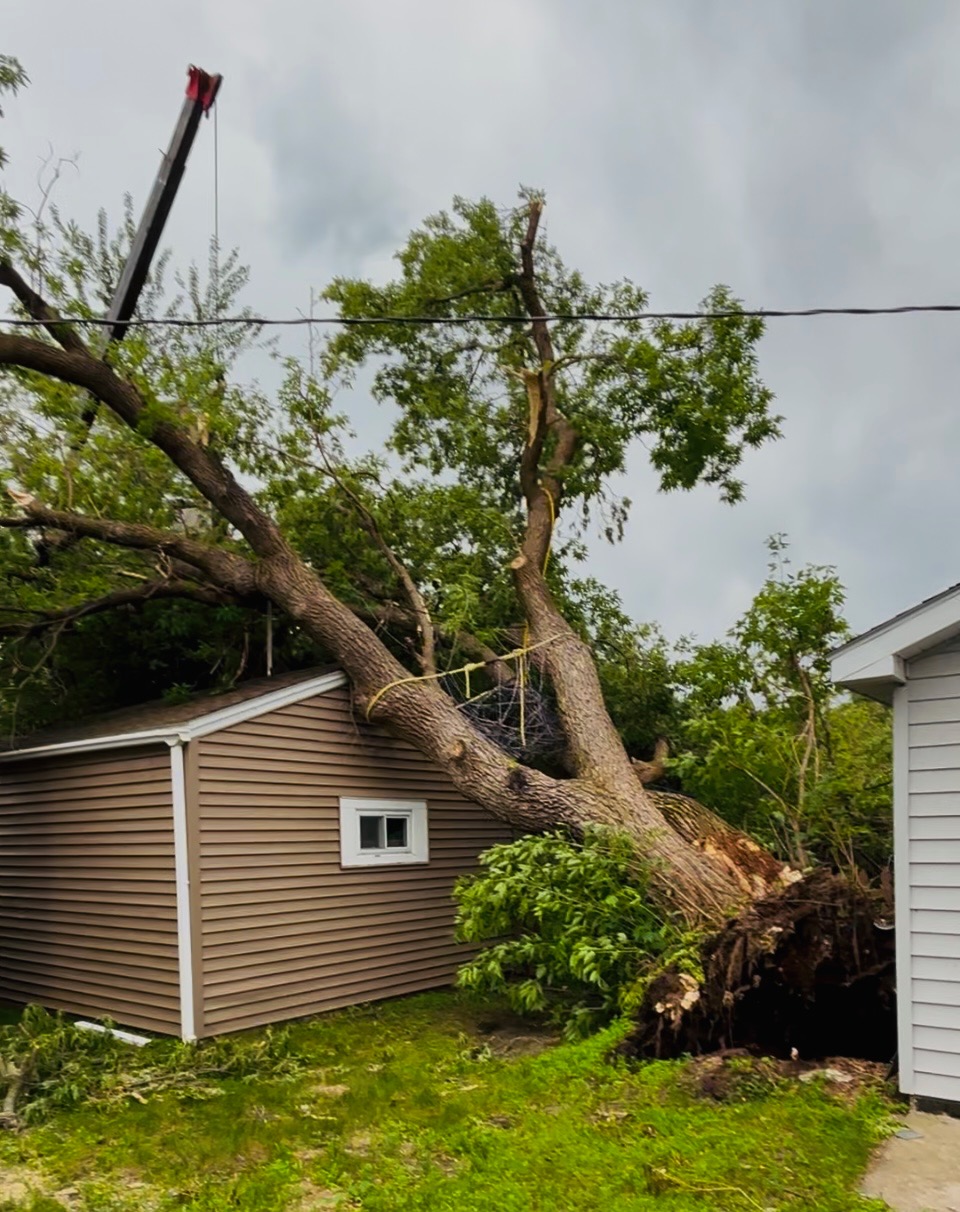
In today’s broadcast, construction is causing even more congestion on a Twin Cities interstate. Then, how some up north are putting a positive spin on the destruction left behind by summer storms. And, what Minnesota is doing to help the agricultural industry to grow.
—–Executive Producer: Victor Palomino Producer: Maija Hecht Anchor: Chantel SinGs Reader scripting: Faaya Adem, Joel GlaserFact checking: Joel Glaser, Victor Palomino Editorial support: Emily Krumberger Mixing & mastering: Chris Harwood
Transcript
[sound element: NSS intro theme]
HOST: You're listening to North Star Stories: Voices from Where We Live, a daily newscast about what it means to live in Minnesota.
ANCHOR: In today's broadcast, construction is causing even more congestion on a Twin Cities interstate. Then, how some up north are putting a positive spin on the destruction left behind by summer storms. And, what Minnesota is doing to help the agricultural industry to grow.
I'm Chantel SinGs.
If you're going to be driving around the Western Metro, the Minnesota Department of Transportation is saying you may want to avoid Interstate 394 until November. MN-Dot is closing the E-Z Pass lanes in both directions between downtown Minneapolis and Highway 100. The closure is necessary to allow crews to repair bridges, ramps, and drainage. The Department says with the E-Z Pass lanes closed, you can expect considerable congestion in the regular lanes. The 79-million dollar project will result in improved accessibility, smoother roads, and extended pavement life.
Ahead, in the wake of what Bemidji locals are calling a once-in-a-generation storm, area woodworkers are taking a 'when life gives you lemons' approach to dealing with the destruction. Maija Hecht has more.
Maija Hecht: In the dead of night on June 20, a microburst hit Bemidji, delivering hurricane force winds that fell 1000s of trees. When the storm subsided, John Enger emerged from his basement where he had sheltered with his wife and baby through the storm.
John Enger: I, you know, got a flashlight and went over to my neighbor's house. I got lost almost immediately, because all my landmarks were gone. My whole yard was full of trees.
Maija Hecht: He made sure his neighbor was alive.
John Enger: Then I spent the next day just chain-sawing my way out.
Maija Hecht: Since the storm, this has become a familiar sound. Emergency responders and citizens alike joined forces to get the power back on, the water running and clear fallen trees amidst the wreckage. Local craftspeople are finding creative ways to keep that wood from going to waste.
John Enger: I bought forest land, and I consider myself sort of a caretaker of it. It's sort of my responsibility now to use the wood, otherwise it'll just rot. I'd just be sick to my stomach if that happened.
Maija Hecht: John runs a small woodworking company called Enger Grove.
John Enger: At this point, I've been milling a lot of beams and a lot of planks because I'm a timber framer. Build a lot of timber frame cabin-sized buildings. Emotionally, it's pretty tough, but the thing that's kind of getting me through is knowing that at least most of the material, that most of these sort of living things, will be used in something, you know, maybe truly beautiful and very long lasting. I find in Bemidji here, a lot of people think that way.
Maxwell Kelsey: That is a way to heal through this.
Maija Hecht: Wood craftsman Maxwell Kelsey woke up from the storm to find his canoe in a nearby lake, about 200 meters from where he stored it.
Maxwell Kelsey: I'm taking this blue spruce tree that fell in my yard that provided years of shade for many families. I'm taking that tree now and I'm going to make canoe paddles for me and my neighbor. We went through that together. That tree was in my yard and fell on his garage.
Maija Hecht: Maxwell is also collecting fallen black ash for his specialty craft, traditional lacrosse sticks.
Maxwell Kelsey: Baaga'adowaan is the stick. Baaga'adowewin is the game.
Maija Hecht: Traditional lacrosse was popular across Anishinaabe country as well as beyond, long before European colonization.
Maxwell Kelsey: I felt that the modern game was really over-anglicized, and I loved the old-style sticks that were known from this area, and I wanted to bring those into the forefront of lacrosse history. So I started doing that, and now other people have too, and it's really growing.
Maija Hecht: Maxwell said that in the wake of the storm--
Maxwell Kelsey: People around here are trying to utilize as much as possible, loggers, tree guys, hobbyists, woodworkers. This is probably also inspiring a lot of people to get into woodworking and turning and carving, because they have this material readily available.
Maija Hecht: Maija Hecht for North Star Stories.
ANCHOR: You are listening to North Star Stories.
Minnesota is launching a $2.4 million initiative to boost careers in agriculture. The new Growing Careers Program will fund workforce training programs that help Minnesotans gain skills for in-demand agricultural jobs. The program will create a pipeline of well-trained workers to meet employer needs and expand entry into agriculture pathways. Grants of up to five hundred thousand dollars will support training in areas like equipment repair, tractor operation, and farm management. The Minnesota Job Skills Partnership is funding the new program.
[sound element: NSS outro theme]
HOST: North Star Stories is produced by AMPERS, diverse radio for Minnesota's communities, with support from the McKnight Foundation and the State of Minnesota. Online at ampers dot org.