
***Beta test for website this is an old segment and not to be downloaded by stations and needs to be deleted from website once test is complete***
Transcript
INTRO/Marie: This week on Minnesota Native… we present the first of three special episodes featuring a Minnesota view of the standoff at Standing Rock over the Dakota Access Pipeline… Our guide is Roy Taylor… host of Indigeneity (IN-DIJ- IN-IT- EE) Now… on K-F- A-I and a member of the Pawnee Nation.
[Roy:]
The confrontation started last April, when a few tribal members set up camp along the Cannonball River, in North Dakota. They wanted to stop construction of a nearly 1200-mile long pipeline intended to carry oil from the shale fields of North Dakota to storage tanks in Southern Illinois. The builder is Energy Transport Partners, and it had hoped the pipeline would be up and running the first part of 20-17. The company says the pipeline will carry half a million barrels of oil a day1 in a cost-effective and safe manner that promotes domestic energy production and environmental responsibility. But there’s a problem. The pipeline passes through cultural and burial sites sacred to Native people. If and when it crosses the Missouri River, it will threaten the Standing Rock tribe’s water supply. The tribe and its allies say they’re determined to protect the ground and the water from an illegal and immoral land grab. On Tuesday thousands of supporters in cities across the United States turned out for a National Day of Solidarity with Standing Rock.
Sound from Army Corps protest: (:30)
More than 300 people showed up for a rally and march in downtown St. Paul. The demonstration took place despite a big victory for the tribes the night before. Late Monday the US Army Corps of Engineers announced it would not grant access to the Missouri River until it got more input from the tribe.
More sot
My name is Colette Routel, and I am a professor at Mitchell Hamline School of Law in St. Paul, Minnesota.
Professor Routel’s is co-Director of the Indian Law Center at Mitchell Hamline. She has represented tribes in litigation and serves the White Earth Nation as an appellate judge.
1:53 Can you give us a brief description in layman's terms of what you think the confrontation is all about, there at Standing Rock?
The confrontation at Standing Rock is one that's actually replicated in many areas across the country. When you look at energy development, it often occurs in areas that are of low population, which are near Indian reservations, in Indian country. As a result, you'll see a conflict between Indian tribes, tribal members, and energy development. If the pipeline or other development was occurring on the reservation itself, the tribe would have veto power.
If the pipeline or other development was occurring on the reservation itself, the tribe would have veto power. They would have say in terms of whether it was built and under what circumstances and the location. Knowing that, many energy developers propose pipelines and other development just outside reservation boundaries, and that's what's happening here at Standing Rock, is there's a large-scale pipeline being built that is not crossing the reservation, but has the potential to really disrupt tribal water resources and other natural resources, as well as sacred sites. That's why the parties are opposed to each other.
The parties are opposed on the ground and also in the courts. The pipeline company says the law is on its side, and the Army Corps delay announced Monday is just political. It says the tribe was offered a chance to participate in public hearings, and refused.
But the tribe says federal law requires government-to-government talks on matters that affect its land or water
CR: The tribe is bringing a request for a preliminary injunction in front of the appellate court now, which they're asking the federal court to tell the pipeline developer, you have to stop constructing the pipeline. But even that takes time. The parties are briefing that, and the court hasn't yet made a decision and won't make a decision for weeks.
Roy: How does this pertain to Minnesota?
18:00 It definitely pertains to Minnesota because you see energy development, and even broader just development, creeping closer and closer to reservations in Minnesota. There are a number of pipelines, of mining projects proposed, fracking. And again, most of these projects are being proposed just on the outskirts of the tribe's territory. They could have huge impacts within the reservation, but the tribe, at this moment, doesn't have the legal right to veto the project because it's not on tribal land, it's not within the reservation. I think this is something that, in particular, is gonna impact White Earth and Leech Lake and other tribes with larger land masses in Minnesota, right away. When you look at the PolyMet mine, for example, not going to be located within a tribe's reservation, but many tribes in northern Minnesota have the right to hunt, fish, and gather off reservation, in the area of that mine, where it's being proposed. That mine could have significant impacts on water quality, on wildlife, on other resources that tribes have federally protected treaty rights to That's why the Standing Rock issue has garnered such support, I think, throughout the Midwest.
Sot of protest
Water is Life
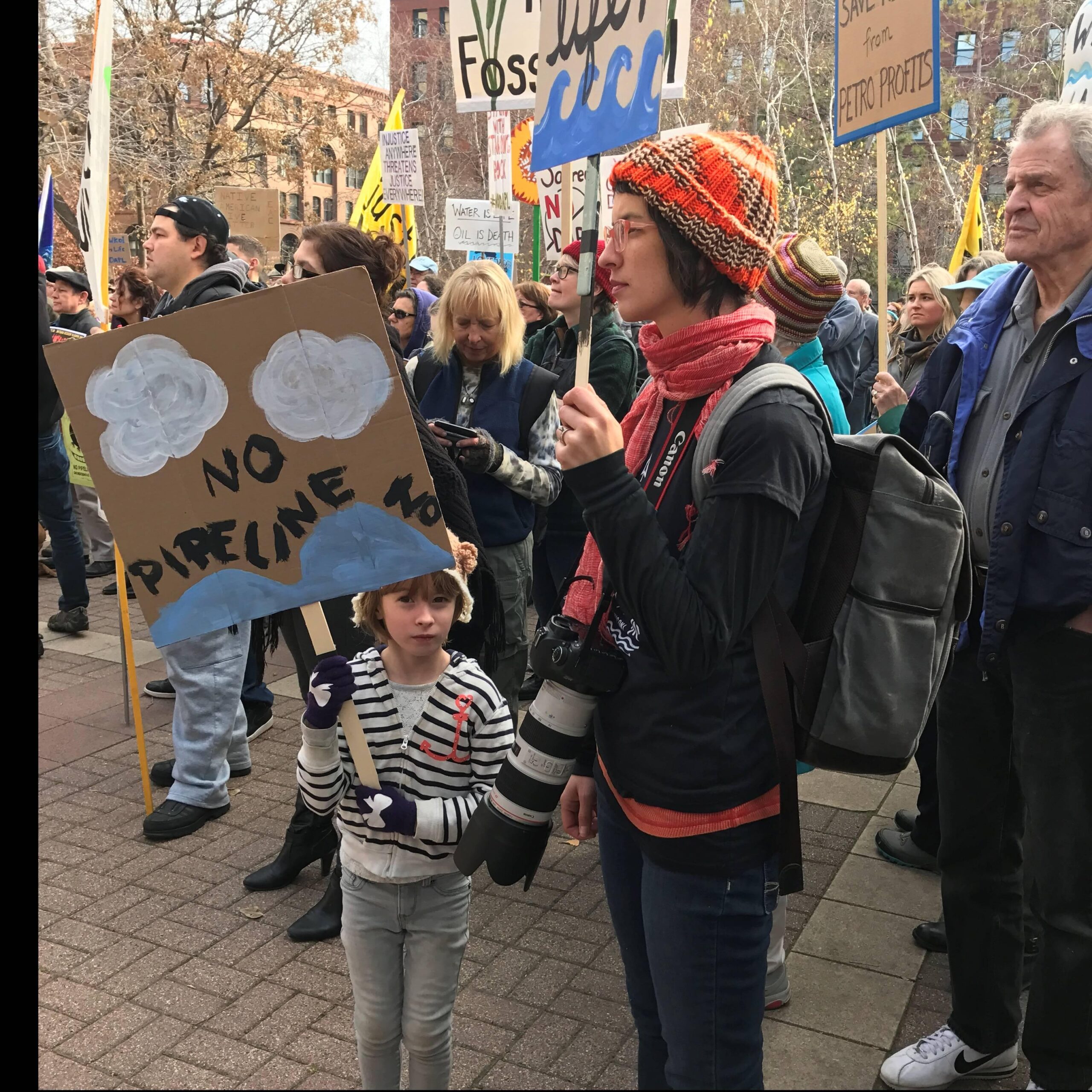
In St. Paul, one of the largest banners Tuesday read “Minnesotans for Climate Justice.” Homemade carboard signs said “We Support the Water Protectors,” “Honor the Earth” and “No Pipeline.”
CR (21): They're moving forward in the final stages of pipeline construction, so we're at a crucial point in time right now. What the tribes really need is, they need to win at the federal appellate level, quickly enough that it'll make a difference, that it can shutdown pipeline construction in this final stage….And get it rerouted.
Colette Routel says tribes and environmental groups have worked together before, but the new administration may unite them in unprecedented ways.
We'll have to see whether, under the Trump administration, there is an increase in energy development and development in general, and how Indian tribes react. Tribes have been faced with much more dire situations and have found a way to pull through them. Now is the time to be proactive, to think about the path forward, and quite frankly, to think about resistance.
(more protest sots)
For its part, Energy Transfer Partners says delays are costly and political and, anyway, the oil can move by rail. Next week on Minnesota Native News, we’ll hear what draws so many native people and their supporters from Minnesota to the tribal camps in North Dakota.