
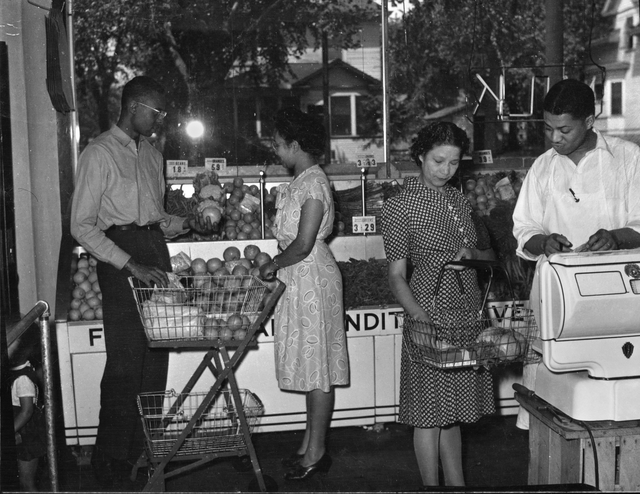
The St. Paul community of Rondo was uprooted in the 1950s by the construction of the I-94 highway, which cut through the heart of Rondo. In this segment, North Star Stories’ Jamad Jama explores how a new generation in Rondo is grappling with the lasting impact of the construction of the I-94 highway. With interviews from Reconnect Rondo and a rondo native, the story focuses on the work being done to revitalize the community.
Transcript
ANCHOR: You're listening to North Star Stories: Voices from Where We Live, a daily newscast about what it means to live in Minnesota.
Jamad Jama: Rondo, a community with a complex and resilient history. In the mid 1950s, as the Twin Cities continued to grow, construction of interstate 94 highway began.
Keith Baker: Then the freeway comes through right through the heart of the community and dismantles the fabric of the community, 700 homes, 300 businesses.
Jamad Jama: Keith Baker is the executive director of ReConnect Rondo.
Keith Baker: I have a bit of background in the nonprofit environment, the philanthropic environment, corporate as well as public sector. So all of those things I kind of bring to the table on the work we're currently doing for ReConnect Rondo.
Jamad Jama: ReConnect Rondo, a St Paul nonprofit founded in 2017 serves the Rondo community through its efforts to bridge the divide that I-94 highway carved into the neighborhood.
Keith Baker: So we're really intending to use our understanding of the impact of the freeway and how the impact of the freeway can be addressed through a restorative movement to re-establish an African American cultural enterprise district, which really essentially was what Rondo was before the freeway came through.
Jamad Jama: For ReConnect Rondo, the solution is a land bridge.
Keith Baker: You know, it's hard sometimes to get our heads around. You know what a land bridge is? There are a whole host of examples in Duluth and other parts in Minnesota. And essentially you have a freeway. But over that freeway, as if going through a tunnel, there is newly created land. The idea surfaced in 2009 and it really was an opportunity for some way in which past harms could be addressed, even if it is merely to connect both sides of the freeway, even if it's a spiritual kind of idea or symbolic idea, both are very, very critical.
Jamad Jama: At the March 3 meeting of the state's House Transportation and Finance Policy committee, elected officials heard community members present concerns about reconnecting Rondo's land bridge proposal. Some Minnesotans believe the project is far too costly.
Representative Nolan West: So we find ourselves in a tough fiscal situation, as we all know, we have a fiscal responsibility to the state to limit excess spending where we can and prioritize what money we do have.
Jamad Jama: That's Representative Nolan West of Blaine. Rashida Jenkins, who spoke on behalf of ReConnect Rondo, countered with--
Rashida Jenkins: I'm not here to talk about the money, because it's about the people. And when I hear people talk about the money and how we need to be responsible, what I'm not hearing is the lives that were impacted.
Jamad Jama: The Minnesota Department of Transportation, or MnDOT, has proposed various alternatives for the I-94 proposal, which usually center around preserving the original highway while making slight variations such as more bussing or newer lanes. Erik Rudeen with MnDOT government affairs.
Erik Rudeen: Just in December, we announced six alternatives that we are proposing to move forward to the next stage of the environmental process, and then a final decision would be made a little less than a year from now.
Jamad Jama: While MnDOT states that many of these alternatives could accommodate a land bridge, some Twin Cities residents are upset, saying the remaining designs limit the possibility of a land bridge. Rebuilding a neighborhood, especially after all that's happened, is a difficult feat to achieve. However, a new generation of residents are motivated.
Kaley Strongarm: From what my parents have told me, you know, it was hard for my grandparents to grow up in that community and then have it all ripped away from them.
Jamad Jama: Kaley Strongarm's story is deeply rooted in Rondo.
Kaley Strongarm: I'm eighteen years old, and I've been living in the Rondo community for my whole life. More specifically, North Rondo. My grandparents were lucky enough to be able to relocate within the neighborhood after the construction of the I-94 highway, but many others were not.
Keith Baker: We are generations and generations removed from what Rondo was, but we always want to make sure there's always this intergenerational piece, because you can't know where you're going without understanding where you've been.
Jamad Jama: While the impacts of I-94 on Rondo are lasting, the community's spirit isn't broken. Many of the new generation of residents are focused on rebuilding, starting with hope. To learn more about ReConnect Rondo and their mission, visit reconnectrondo.com/ Gor North Star Stories. I'm Jamad Jama.
ANCHOR: North Star Stories is produced by AMPERS, diverse radio for Minnesota's communities, with support from the McKnight Foundation and the State of Minnesota. Online at ampers dot org.