
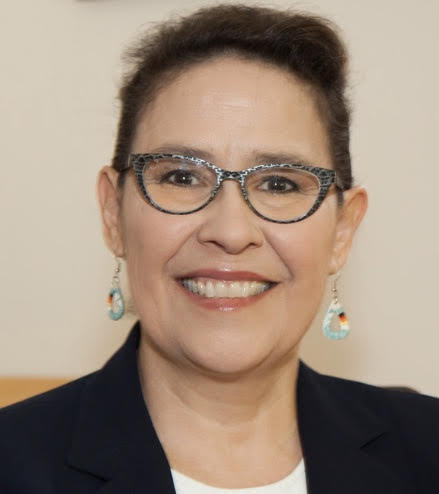
This week on Minnesota Native News, a profile of a remarkable leader. Laurie Stern has the story of Terri Yellowhammer, who was just sworn in as a new Minnesota state judge. She will serve in Minnesota’s 4th judicial district, or Hennepin. County.
Transcript
This week on Minnesota Native News, a profile of a remarkable leader. I’m Marie Rock, and Laurie Stern has the story of Terri Yellowhammer, who was just sworn in as one Minnesota’s new state judges. She will serve in Minnesota’s 4th judicial district, or Hennepin. County.
I'm Terri yellow hammer. I am enrolled in the Standing Rock Sioux Tribe. I have heritage with the White Earth nation through my mother.
Terri Yellowhammer grew up in North Minneapolis and the Phillips neighborhood. She visited the Standing Rock and White Earth reservations with her parents, Walter and Joyce Yellowhammer, but never lived there.
So, my parents, instilled and I a real sense of who we are, as native people, you know, it was important that we knew where we were enrolled, and that we were also Ojibwe. And just a real strong sense of pride. I remember, I think it was in eighth or ninth grade and being really surprised to learn that one of my classmates had some shame around being Indian… that was foreign to me, because I had always grown up being very proud of being native.
Judge Yellowhammer says when she was very little she wanted to be a ballerina, but in college she majored in journalism. When her 2nd child was born with a serious seizure disorder she thought about becoming a nurse.
I had to educate myself about her condition and you know, in order to hang in there with the doctors and detain, challenge them and hold them accountable, make sure they were getting my data, the best care.
But nursing didn’t quite fit. Instead, she listened to her father, Walter Yellowhammer, who worked at the legal rights center and thought Terri would be a good lawyer.
Well, I knew that I wanted to be a lawyer to help people. I knew that I wanted to be in court. I like thinking on my feet. I like being a voice for the voiceless. I like standing up against injustice. And I wanted to serve my community.
She began her law career with the attorney general’s office, but soon moved to the Indian Child Welfare Law Center. She was active with Migizi and as a guardian ad litem with Hennepin County
And I started doing home visits for some of the children that were in my some of my programs, and I tell you, you know, going into the homes of his single parents, mainly native women, and trying to establish a connection and getting a sense for what their lives were like, was very eye opening for me and sobering. And I, again, to kind of respect for how hard those women worked to make the best lives that they could for their children, and it wasn't easy for them. So that really helped instill in me a real purpose, a sense of purpose, and serving my community.
She visited White Earth frequently, with her family and for work. There she was mentored by Judge Anita Fineday, who eventually appointed Terri to be a tribal court judge.
And one of the things that Anita Fineday taught me was the importance of making sure that people that came into our courtroom felt like they could speak and they would be heard. I got there, and I was kind of getting into Oh, I'm going to be a judge. I thought, oh, I'll have this robe. And I asked her, you know, so we have robes or wear the robes? And she said, Well, we can get you one if you want one. I said, Well, you don't wear one. And she said no. I said, Well, why not? And she said, because we're already removed from the people. I don't want to feel any more removed from them, or intimidating. And I thought that was pretty deep. So I followed her lead, I did not wear a robe on the bench.
Judge Yellowhammer wants to make the justice system work better for her community and for everyone. That’s why she went through the ordeal of applying to be named a judge. She names several judges who mentored her, and the Minnesota Association of Black lawyers, which invited her to participate in mock interviews.
So do you have the option to wear a robe or not wear a robe in the fourth district? And what will you do? No, no,
we wear robes. And as, as much as it made sense, in tribal court, I think it would be confusing down here. I think people need to know you're in their courtroom, you're in charge, and you know, what you're doing? And the robe is a symbol of that.
Judge Yellowhammer has what she calls judge school for a few more weeks and she will start hearing her first cases the beginning of 2021. For MNN I’m LS.