
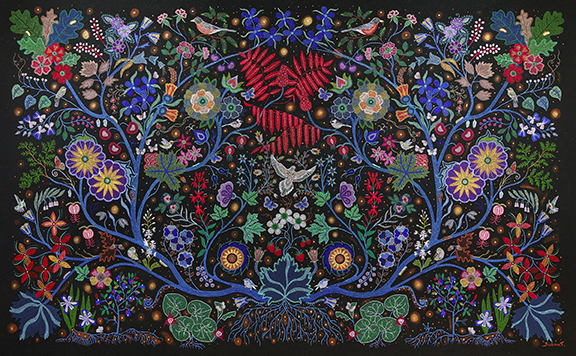
A new exhibit at the Minneapolis Institute of Art honors indigenous women artists from many nations in North America.
Transcript
Headlines:
Marie: This week on Minnesota Native News, a first-of-its-kind celebration of Native women.
This is Minnesota Native News. I’m Marie Rock.
[Story #1 Hearts of our Peope]
[Marie:]
A new exhibit at the Minneapolis Institute of Art – or Mia – honors indigenous women artists from many nations in North America. Reporter Laurie Stern met up with Mia’s Dakota Hoska for a tour.
Tape: Lakota greeting My name is Dakota. I'm a Lakota woman enrolled in the Pine Ridge reservation and I live in the twin cities.
Laurie: Dakota Hoska is a painter who has spent much of her adult life making and studying art. She’s been working for Mia on the new exhibit for four years.
Dakota Hoska
one of my favorite parts is this Rose Simpson tricked out El Camino. And this is a car that this artist built from the ground up
Laurie: I had noticed the black lowrider-pickup in the middle of the room, but for some reason I didn’t realize we were already in the exhibit. Dakota Hoska pointed out the detail:
The black glossy design on the black matte finish; the black suede covers on the black leather seats; the metal work on the mirrors, handles and grille, the rebuilt engine, the pulsing sound system, the special brakes a powerful car needs – it’s all part of Rose Simpson’s idea.
Dakota Hoska
She still drives this car. She actually offered to drive it up for the exhibition. We're like, no, no, no. We'll ship it.
Laurie: Rose Simpson – the artist – lives in Espanola New Mexico, which is the self-proclaimed lowrider capital of the world. Simpson has been working on cars since she was 12. She named this 1985 El Camino “Maria.” It’s design honors traditional black-on-black Pueblo pottery. It’s power defies machismo culture.
Dakota Hoska
her artwork just in general does challenge gender stereotypes. So she's doing a lot about questioning gender, questioning power questioning tradition and stereotypes and it's all kind of encapsulated in this one work.
Laurie: Just beyond the El Camino is a gallery with a video screen. The artist Mona Smith recorded the activist Juanita Espinosa greeting visitors to the exhibit. This is Juanita.
Juanita
I am Dakota Ojibwe from Spirit Lake nation and I've lived in the twin cities for about 40. You told my knowledge of, of what I understand to be date of art is that it's the act of doing, because there is no word for art in our culture specifically. Many of us forget that in this culture that we've come to adapt to. Um, it puts labels and titles on who we are and how we should be, and then it creates a measure in our way of life. The act of doing and creating and sharing encourages a communal family approach to how we live our lives and how we, um, encourage each other. So there is no scale but only a recognition of the act of being a maker.
Laurie: After the greeting from Juanita Espinosa, visitors enter galleries that display regalia, paintings, videos, sculptures and other installations, each one as carefully curated as it was made. A panel next to each piece of art tells visitors about the artist and the context – in English and, where possible, in the language of the maker. Dakota Hoska says at last count 68 languages were represented.
Dakota Hoska:
We were Gung Ho about translating all of the languages, but some communities came back and said, you know, we don't share our translations with the outside world, you know. So there, there was a lot of like give and take and deep listening. I think that was important in, you know, it's, it's really hard to listen deeply because we're not used to doing that.
So it was hard. It was hard for a Western institution who is running on like deadlines and timelines. And budgets and those things like deep listening kind of pushes the boundaries on all of those things.
Maybe good art always pushes boundaries, but THIS exhibit does it deliberately. Every single piece challenges conventional thinking. The exhibit was produced by a 21-member all-woman, mostly Native board. It will be at Mia through August 18, but will live on in a catalogue that’s available at the bookstore or online.
Dakota:
a lot of them were saying, I was looking for this stuff in the scholarship and I couldn't find that. I want to leave a legacy for our children. I want our young women artists to be able to find this when they are looking. And so like the catalog that the exhibition is great and I love it, but the catalog was in some ways more important for us because that was really a directive from our board that we created something that went on.
MARIE: You can see “Hearts of Our People” at no cost if you’re Native. You just have to say so at the ticket desk. You can learn more about the exhibit by visiting artsmia.org.