
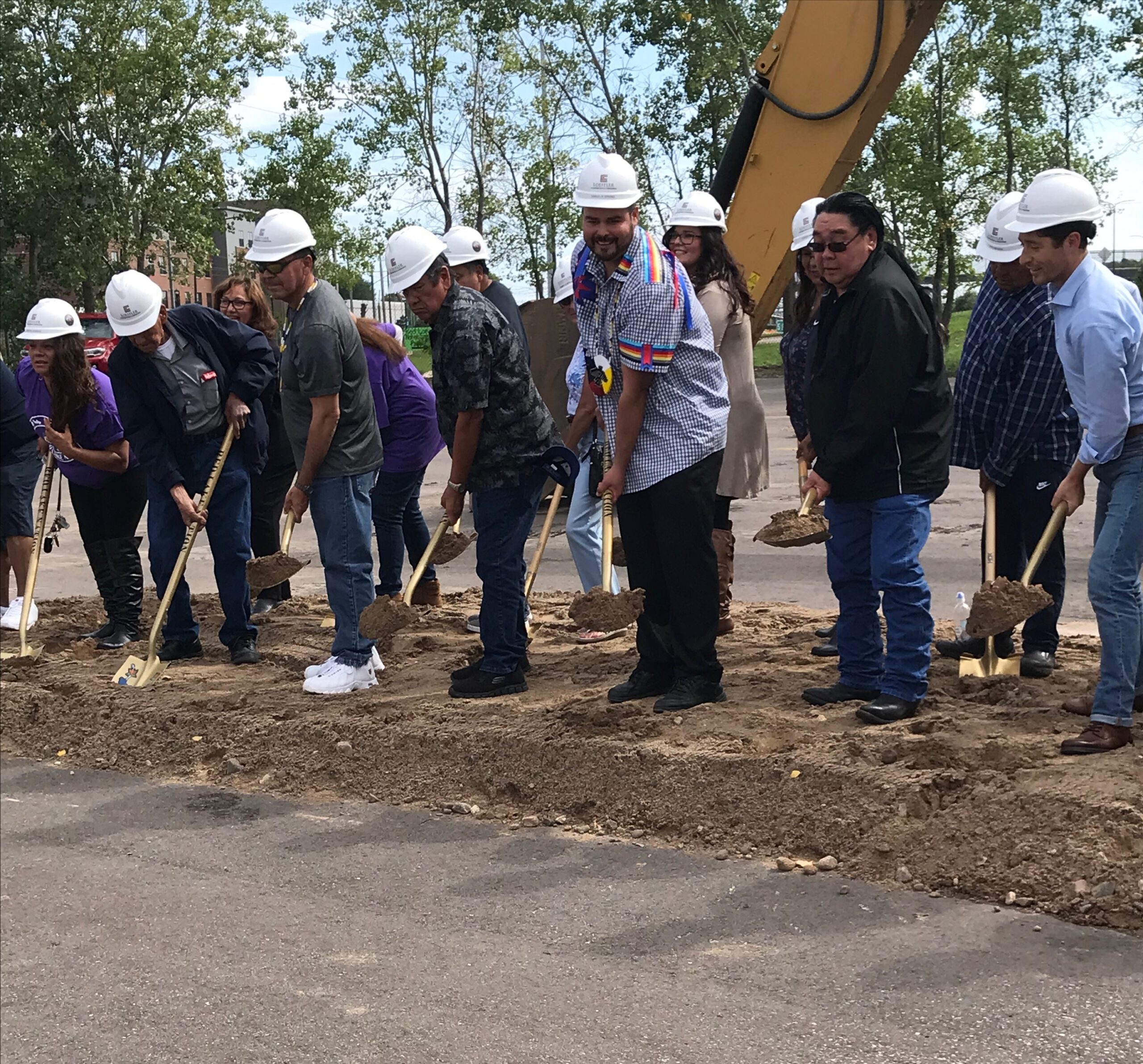
This week on Minnesota Native News, a groundbreaking, a grand opening and an update on wild rice. Red Lake Nation’s new housing project is underway near last year’s Wall of Forgotten Natives.
Transcript
Headlines:
Marie: This week on Minnesota Native News, a groundbreaking, a grand opening and a mid-season update.
This is Minnesota Native News. I’m Marie Rock.
[Story #1 Mino-bimaadiziwin}
[Marie:]
Hundreds of people celebrated on the site of the last year’s homeless encampment in Minneapolis. They were celebrating a Native-led affordable housing project that broke ground over the weekend. Laurie Stern reports.
[1-2-3 yayayayay…] That’s the sound of two dozen shovels biting into the dirt to celebrate a milestone. Construction has begun for a 110-unit apartment building that will house low-income and formerly homeless people. The land is owned by Red Lake Nation, which is developing the project just blocks from the Native cultural corridor on Franklin Avenue. Sam Strong is secretary of Red Lake Nation.
Sam: a year and a half from now, we're going to have our drums out here. We're going to be teaching our kids to the language. We're going to be helping our people overcome the addiction struggles that they're dealing with. And we're going to, we're going to have a place to call home.
Red Lake is working with Minneapolis, state and federal officials to make sure the new permanent housing will serve community needs.
Sam:
when the system is broken, it must be fixed. And so we're working on fixing the system. And this development has really been a huge impetus for not only Red Lakers, but for all native people to say, wait a second. If we're the most underserved, under representative portion of the population, why are these laws that are meant to protect us, hurting us.
Plans for the project have been underway since 2015. It’s called Meenobeemadizzy-man, the good life. The new units should be ready in 2021.
[Story Two Migizi]
Marie: Native Minnesota and allies also turned out for the grand opening of Migizi (Mih-GIZZ-ee) Communications in its new space just off Lake Street near South High School. The 40-plus-year-old nonprofit trains Native youth to tell their own stories and stories of their communities. The spacious new location features a media studio, an art gallery and plenty of gathering space. Kelly: I am Kelly Drummer, executive director of Migizi Communitcations, Lieutenant Gov. Peggy Flanagan is here, Mayor Jacob Fry is here, we are thrilled to be in this new space with so many supporters. Bdishekwe: It's been so quiet til tonight. This is Bdishekwe {bah-DEESH-ee-kway} Means. She started at Migizi in high school and now is part of the staff.
Bdishekwe:
we have a green jobs program and we have cultural programs like sacred visions and we do homework help and things like that for the community. And so we're just, we're always working with youth and trying to build that next generation to make sure that, you know, one, they're getting livable wage jobs and that they're educated, um, and that they know how to navigate throughout our community.
[Story Three wild-rice harvest]
Marie: Now that we’re well into the wild rice season, we thought we’d check in with Jeff Savage, a lifelong harvester and member of the Fond du Lac Band of Lake Superior Chippewa.
Jeff: Now that I’m older I’m teaching my grandchildren, went out with my 14-year-old grandson this year.
Marie: Jeff said they had to go west to find good rice though. He says so far the harvest hasn’t been great on Leech Lake either, but it’s okay on White Earth.
Jeff Savage
As Anishinabe people it is our sacred responsibility to go where the food grows on the water and to be caretakers///And then we have these other issues like a mining waste, invasive species that are very serious disruptors to not only this//And then we have all of this we have to deal with and still try to keep the wild race for the future generations. So it’s not just a food product it’s also the way we identify ourselves.