
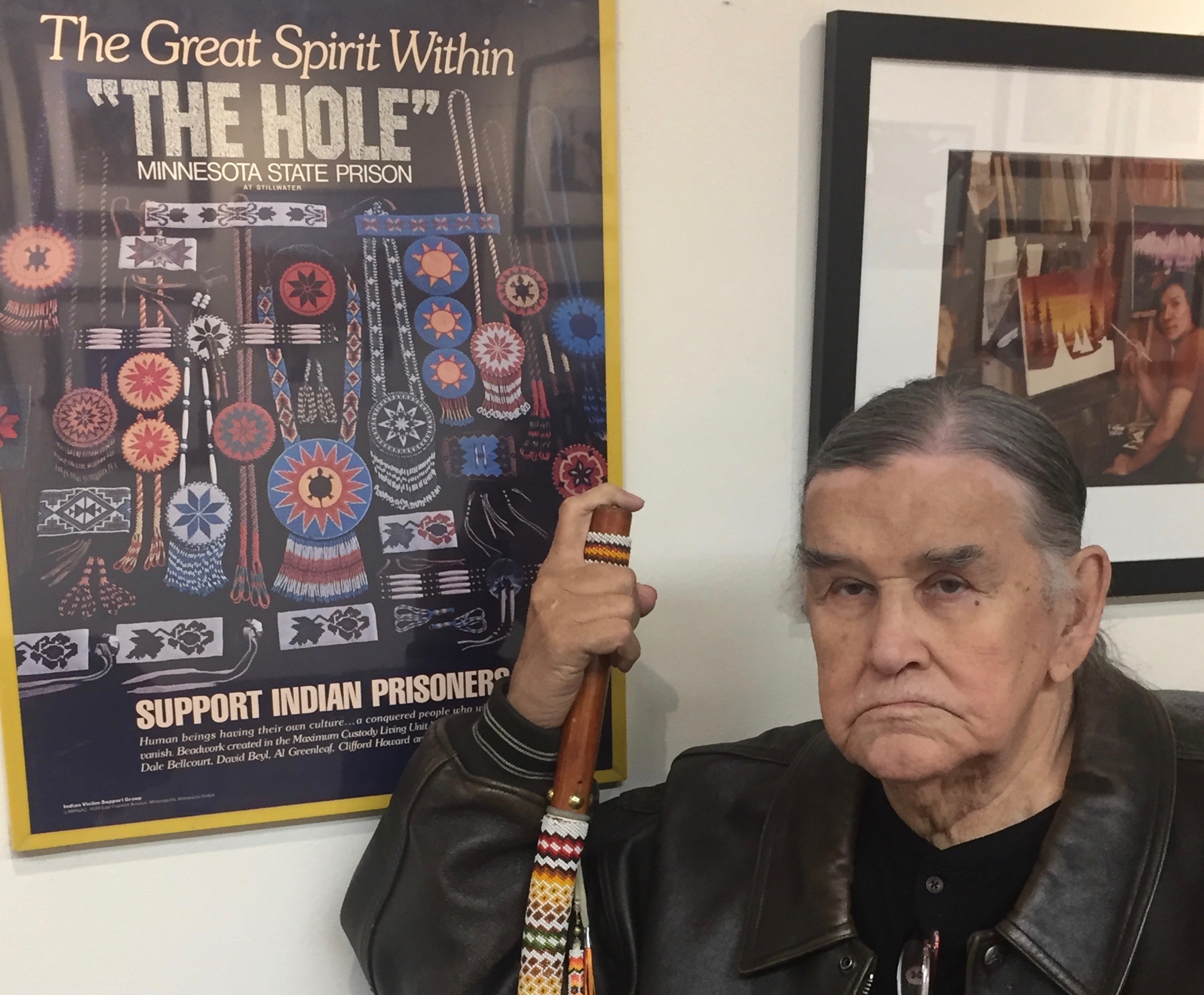
A new exhibit of photos provides a look into cultural education programs for Native inmates at Stillwater Prison in the 1960s and 70s.
Transcript
A new exhibit of photos provides a look into cultural education programs for Native inmates at Stillwater Prison in the 1960s and 70s.
Reporter Melissa Townsend explored the exhibit and has this story.
REPORTER: Well, let’s do an intro of you - do you want to introduce yourself?
BIRD: My name is Eric Bird and I’m archivist and curator at AIM Interpretive Center. (:09)
The center on Franklin Avenue in Minneapolis is basically an archive of all things AIM.
BIRD: Yea, the center means to tell the story of the movement from the beginnings from a local anti-police brutality patrol to national and international activism for indigenous people. (:08)
Eric and I are standing in front of a wall of photos - part of the current exhibit called The Great Spirit within “The Hole”.
Each image is from inside Stillwater Prison in the early 1980s where Clyde Bellecourt and Eddie Benton-Banai led a program teaching Native inmates about Ojibwe culture.
They started it in 1962.
BELLECOURT: We had it twice a week, culture program. Every time we had a meeting we started with a drum because that drum was sacred. (:08)
Clyde Bellecourt says many of the men there were hearing these cultural lessons for the very first time.
BELLECOURT: You learn all about the Ojibwe culture and sundances and all that — which we didn’t know nothing about. They don’t teach that in the public and parochial school system. (:10)
Curator Eric Bird describes the photos.
BIRD: Some of the pictures show the walls of the classrooms are full of AIM posters and flyers from the broad so-called Red Power movement and Indian Resistance.
REPORTER: There’s something about it, like - without those pictures, drawings on the walls, they’d be blank right - so it’s a blank space that they then fill with the images that they choose. They are not compromised images right. They’re like, these are drawings we drew, and we are teaching ourselves … like we are creating our image of who we are.
BIRD: mmhmm. (:42)
As a young man in Stillwater prison in the 1960s, - Bellecourt was held in solitary confinement because he wouldn’t follow orders.
For one, he refused to work a prison job.
BELLECOURT: People got their fingers torn off from spinning twine for the state of Minnesota others had their fingers stamped from making license plates. (:11)
But - with the support of the warden — Bellecourt connected with Eddie Benton-Binai.
And the two created a space where they were asked Native inmates to explore their own identities as Native men.
Eric Bird, the curator of the AIM Interpretive Center exhibit says their experience in prison spurred many AIM founders to find power within themselves and a path forward - out of prison.
BIRD: The experience of incarceration is something that’s very important in autobiographies of AIM leaders. I’m thinking of Clyde Bellecourt, Dennis Banks, Eddie Benton-Banai. (:11)
These kinds of cultural education programs are no longer in Minnesota state prisons.
But one man is leading an effort to change that.
John Poupart is lobbying for funding for cultural programs to encourage Native inmates - both men and women - to find the Red Road.
It could ease re-entry into the community and reduce recidivism.
He says he is hopeful that with the first Ojibwe Lieutenant Governor in office — this issue may gain the attention it deserves.
For Minnesota Native News, I’m Melissa Townsend.