
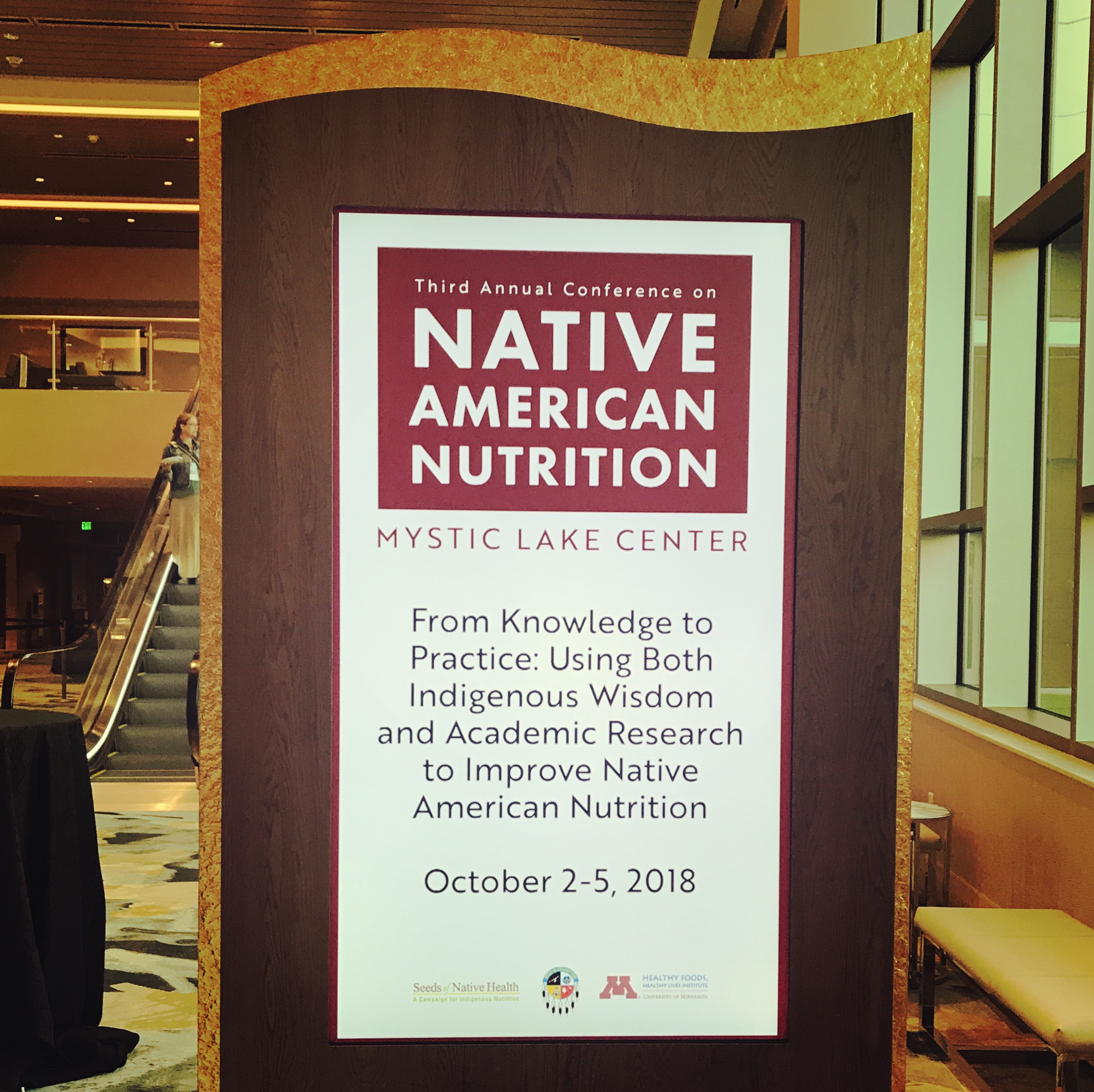
Six hundred people gathered at Mystic Lake Conference Center in Prior Lake for the Third Annual Conference on Native American Nutrition. Tribal leaders, nutrition practitioners, researchers, students, and many more gathered to learn, share, and visit with one another.
Transcript
Marie: This is Minnesota Native News, I’m Marie Rock.
Headlines: Coming up… we check on a major campaign to restore healthy diets for Native Americans.
Six hundred people gathered at Mystic Lake Conference Center in Prior Lake for the Third Annual Conference on Native American Nutrition.
Tribal leaders, nutrition practitioners, researchers, students, and many more gathered to learn, share, and visit with one another.
Here is Leah Lemm with the story:
STORY #1 THIRD ANNUAL CONFERENCE ON NATIVE AMERICAN NUTRITION
REPORTER: The Third Annual Conference on Native American Nutrition was held in early October at the newly built conference center at the Shakopee Mdewakanton Sioux Community’s Mystic Lake Center.
Even with overcast skies, the center was bright and airy, and full of energy.
SOUNDS FROM MORNING INTRO
I spoke with Jesse Chase, Chair of the Shakopee Mdewakanton Sioux Community’ Seeds of Native Health Campaign, which put on the conference in partnership with the University of Minnesota.
CHASE: Seeds of Native Health is a four year, $10,000,000 campaign to improve Native nutrition, food access, and to fund advocacy campaigns across Indian Country. We partnered three years ago to begin the Native American Nutrition Conference as a way to get traditional knowledge and academic knowledge about native nutrition together.
REPORTER: And so they did. I read through the agenda and found topics such as…
Reclaiming the Tradition of Breastfeeding: The Foundation of a Nation…
Alaska Traditional Foods Movement …
and The Role of Soil Nourishment in Nutritional Quality of Indigenous Foods…
These are just three of the nearly 60 available sessions, and that doesn’t include the pre-conference foraging and cooking presentations.
The demand and interest in topics like these is evident in the growing number of participants.
CHASE: We've had just incredible turnout this year. Two years ago we had 400 people. This year we have almost 600. I really think this is something a lot of people care about just to see the growth that we've had.
REPORTER: And there is urgency to these topics.
Professor Mindy Kurzer is in the chair of the conference and is the Director of the Healthy Foods Healthy Lives Institute at the University of Minnesota.
KURZER: The issues are so urgent and so pressing and indigenous people are so invisible in this country that when people, it is very obvious to me that even progressive people who are non-indigenous, when they talk about disparities of any kind, whether it's health disparities or education disparities, don't mention native people.
REPORTER: Noteably, the conference has a particular awareness of the nuanced relationship between academia and tribal communities.
KURZER: There's been a lot of mistrust on the part of native communities of research in general and academic approaches to studying indigenous communities. And so this conference is part of a movement to heal that and work together, take the best of both worlds.
REPORTER: Professor Kurzer is referring to a history of exploitation… on the part of researchers… with many Native communities, and the culturally and humanly insensitive methods by which information was often obtained.
Part of that healing… in bringing together the best of both worlds… includes a lot of good *visiting.*
Ernie Whiteman, a panelist and presenter at the conference, is the Cultural Director of Dream of Wild Health…. An organization in Hugo, Minnesota…. He remarked on the importance of having the opportunity to network...
WHITEMAN: It’s a unique onference, I think that attracts a lot of people from all over Indian Country. We all are dealing with common things in our communities, you know. And so I think this place is like a resourceful place to come and to gather and to meet and to share ideas with one another and to solve problems.
REPORTER: Obesity rates… in 2015… for American Indian and Alaskan Natives was nearly 44%… and lack of access to fresh foods is a challenge common for many tribal communities.
This conference provides those working to combat these statistics the powerful tools of knowledge and connections.
WHITEMAN: It’s up to us as people that attend these conferences, participating in this conference to take home something or some things and apply it to your community.
REPORTER: The conference takes place again in September 2019.
For Minnesota Native News, I’m Leah Lemm.