
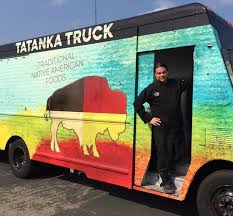
This week on Minnesota Native News: White Earth’s new food truck and Hennepin County Judges reach out to the urban Native community.
Transcript
HEADLINES: This week on Minnesota Native News: White Earth’s new food truck… and Hennepin County Judges Outreach to the urban Native community.
STORY #1 - WHITE EARTH FOOD TRUCK (3:40)
HOST: The White Earth Band of Ojibwe is now the proud owner of a food truck!
The kitchen on wheels is part of the White Earth Food Sovereignty Initiative that aims to get affordable, traditional and healthy foods in the bellies of tribal members.
Reporter Melissa Townsend has more details.
REPORTER: Over the past few years the White Earth Nation has been finding ways to grow its own healthy traditional food.
The tribe bought a 20 acre community farm.
and NOW the tribe owns a food truck that will deliver food and demonstrate ways to cook it.
Zach Paige is the Food Sovereignty Coordinator for the White Earth Natural Resources Department.
Paige says the new White Earth food truck is a vital part of the tribe’s plan to create this sovereign food system.
PAIGE: There aren’t a lot of grocery stores in White Earth. It’s about a 30 or even a 40 minute drive to Walmart or to the closest grocery store so people do end up shopping at gas stations here that have limited healthy foods. They may have chips and pop and stuff like that. (:23)
That selection of processed, fatty and sugary foods is taking a toll on White Earth tribal members.
Diane McArthur is the tribe’s dietitian. She works with diabetes patients.
MCARTHUR: I’ve seen some that are 12, 14, right around that 12, 13 age. My theory on that is they were introduced to processed food from the time they were eating solids. (:11)
REPORTER: How do you help them shift from something they’ve kind of grown up with?
MCARTHUR: That is a hard task. These processed foods are actually made in food labs where they test them on people to see how the brain reacts to these foods. They are specifically made to keep us coming back for more. (:20)
White Earth was initially going to buy a van that would travel around the reservation and sell healthy food.
That would at least get locally grown produce closer to tribal members.
But Diane says, it’s not enough to make food available.
MCARTHUR: We have to do the cooking piece ‘cause you can give people these foods and they’re going to look at it like - What am I going do to with this? And if you can show them recipes, get them to taste things, and understand, hey this is a good way to cook it…(:12)
As luck would have it - a food truck with an indigenous food history became available.
The famous Minneapolis based Dakota chef Sean Sherman started the Tatanka food truck in 2015.
It had motored around the Twin Cities serving up indigenous American food ever since.
But Sherman is planning to open a restaurant in Minneapolis so he decided to sell the Tatanka truck.
And with a grant from Indian Health Services, White Earth bought it.
Zach Paige says the truck just got a make-over, and now has the White Earth logo on it.
PAIGE: Our Logo is the White Earth market - something people can recognize like the Schwan’s truck. (:05)
The tribe is hosting community meetings around the reservation to get input on the route the truck will travel, and the best ways to engage the locals.
The truck is scheduled to get rolling this spring.
Tribal dietitian Diane McArthur says this is a good step to increasing healthy eating.
MCARTHUR: We didn’t get to this place over night, and I don’t see that we are going shift overnight. We got to keep working at it. (:08)
Tribal members will be able to use cash and food assistance like SNAP and WIC to buy food from the truck.
For Minnesota Native News, I’m Melissa Townsend.
STORY #2 - TELL IT TO THE JUDGE (1:45)
HOST: Judges on the Hennepin Country District Court are reaching out to American Indians living in the county - to hear about their experiences in family court.
Family court hears cases involving child custody, divorce and domestic violence.
White Earth descendent Anne McKeig (mc-keg) was a judge in the Hennepin County family court before she was appointed as a Justice on the state Supreme Court in fall of 2016.
She says she is still involved in the county judicial listening sessions.
MCKEIG: I had noticed that there were just no litigants coming to court. I mean we know that domestic violence is a huge issues in Indian Country. We know that 1 in 3 women experience physical or sexual assault in their lifetime, so I didn’t understand why with a large urban indian population, why we were’t seeing those litigants. So we went out to the community and held some listening sessions to say what would you like to see from the court? (:27)
She says Hennepin County judges got an earful.
Native people need the law enforcement to be more effective in enforcing court orders.
MCKEIG: We heard loud and clear that there is a concern in the community that even if they get a civil order for protection, they have trouble enforcing that order for protection and that’s due to some relationships that need to be furthered between law enforcement and the Native community. (:16)
The judicial listening sessions are part of a U.S. Department of Justice initiative to make county courts more effective….
And Hennepin county’s approach will serve as a model for their other communities around the country.