
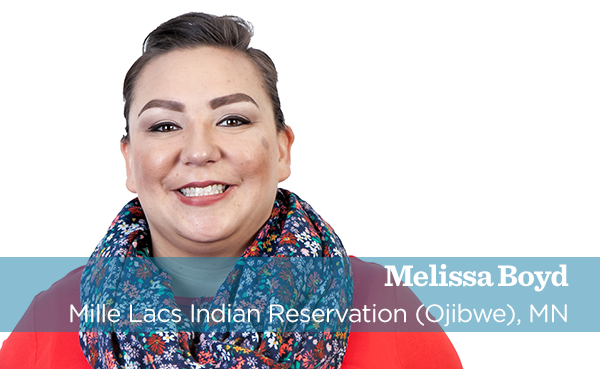
This week on Minnesota Native News, a new Bush Fellow talks about her plans for an Ojibwe language pipeline on the Mille Lacs Reservation, a new online database will help protect Native burial sites and the state legislature invests less in Native language revitalization programs.
Transcript
HEADLINES: This week on Minnesota Native News, a new Bush Fellow talks about her plans for an Ojibwe language pipeline on the Mill Lacs Reservation, a new online database will help protect Native burial sites and the state legislature invests less in Native language revitalization programs.
STORY # — MELISSA BOYD BUSH FELLOW (2:20)
Earlier this spring the Bush Foundation announced 24 people had been awarded Bush Fellowships for 2017.
The fellowships are designed to pay for education and experience people need to become more effective leaders in their home communities.
Mill Lacs Band citizen Melissa Boyd is among the fellows.
Reporter Melissa Townsend spoke with her about her plans for the award.
About 10 years ago Melissa Boyd left college to come home to the Mill Lacs reservation.
She got a job working with a language apprenticeship program.
She was learning Ojibwe from elders and turning around and teaching preschool students the language.
Around 2012 Mill Lacs expanded their early childhood center, and Melissa asked if she could start an Ojibwe immersion classroom.
BOYD: I wanted a space for language to grow like a little incubator. (:04)
She was emulating the work that she’d heard about in Hawaii and New Zealand and closer to home - at an Ojibwe immersion school in Hayward, Wisconsin.
The immersion classroom at Mill Lacs opened and Melissa says it was pretty successful.
BOYD: Anything a preschool child goes through we did that in the language - i’m talking wiping noses, wiping bottoms, everything you could think of. And so it was exposure and experience for families who wouldn’t have gotten that opportunity to participate or have their children involved. (:15)
She started to dream about expanding the program to create a pipeline so babies could continue to learn the language into adulthoood…
but she ran into big challenges because she didn’t have the formal training to build a new culturally appropriate Ojibwe language program that spanned the generations.
That’s where this Bush Fellowship comes in.
BOYD: The fellowship is allowing me to move forward in my education about the work I’m in so I can be better prepared to help other teachers do the workday I can help mobilize a school and help create a more culturally responsible system. (:18)
Melissa is finishing up her Certificate of Contemporary Indigenous Multilingualism from the University of Hawaii Hee-lo and she is starting full time at The College of Saint Scholastica.
She plans to bring a level of professionalism to her work building a culturally specific Ojibwe language program for all ages.
For Minnesota Native News, I’m Melissa Townsend.
STORY #2 - MIAC LANGUAGE GRANTS (:52)
Among the many issues in front of state legislators this year was the state’s investment in revitalizing Native languages.
The Minnesota Indian Affairs Council had requested an increase in funds to support Ojibwe and Dakota language programs.
Dennis Olson is the Executive Director of the state’s Indian Affairs Council.
OLSON: We’ve been really active throughout the legislative session testifying in the Legacy finance committee on the house and the senate side. (:07)
The final allocation was slightly less than the previous biennium.
Over the next two years, the Council will distribute nearly one and half million dollars in grants to Ojibwe and Dakota language programs.
Just under one million will be distributed through competitive grants to language programs around the state.
And another 500 thousand dollars is ear-marked for the Wicoie Nandagikendan [wah-CHO-wee nan-dih-CAY-nahn] Urban Immersion Early Childhood Project in Minneapolis.
STORY #3 - OSA PORTAL (1:03)
Construction season is getting underway, and unfortunately that often leads to accidental disturbances of Native archeological and burial sites.
A coalition of state agencies are working together to change that.
The state archeologist, department of transportation and the Minnesota Indian Affairs Council are redoing/upgrading a digital database of these significant sites.
Melissa Cerda [serdah] is the Cultural Resource Specialist for the Minnesota Indian Affairs Council.
She is one of the key people at the Council who works to protect burial and other sacred sites.
CERDA: For my job I get an EIS telling me that there is going to be some sort of construction passing near some mounds. So we have to dig through our files to see if we are going to allow it or see what next steps to take. (:13)
She says the new online database — called the O-S-A portal - is going to be a one stop shop for the mapped location and the known history — of every recorded archeological and burial site across the state.
The new online portal will help municipal, county and state construction crews steer clear of culturally sensitive areas.