
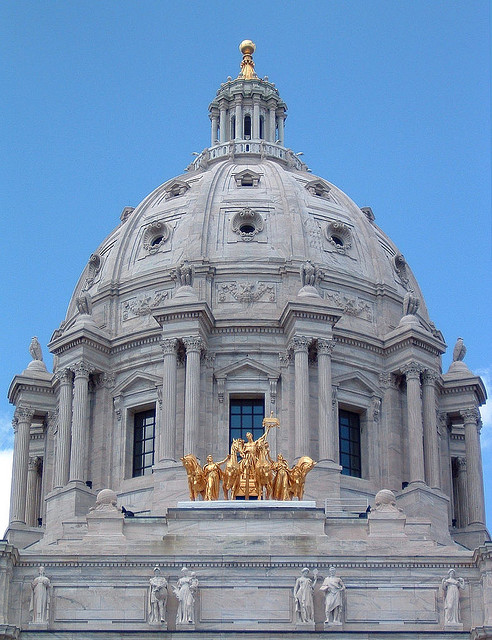
This week on Minnesota Native News we look back at the legislative session and two proposals that will impact tribes and Native people in the state.
Transcript
Headlines: This week on Minnesota Native News we look back at the legislative session and two proposals that will impact tribes and Native people in the state.
STORY #1 - RED LAKE SCHOOL DISTRICT IS APPROVED FOR $14M IN BONDING (1:30)
This is Melinda Crowley’s first year as Superintendent of the Red Lake School District. And this year, she and the district’s leadership team requested 14 and a 1/2 million dollars from the legislature.
CROWLEY: We have children that are getting classes in closets and other hallway facilities, etc.
This year 99.4 percent of Red Lake students are American Indian and the number of children entering elementary school is growing every year.
Willie Larson, the Red Lake School District Business Manager, says the cafeteria needs a huge redesign.
LARSON: When you have a cafeteria designed for 300 kids and you trying to put 600 kids through there for breakfast, it just doesn’t work. (:08)
So Crowley and Larson got to work when the legislative session began.
CROWLEY: Well, number one, we’ve been going for this for quite a few years. So lots of work has been done previously. I spent a fair amount of time this year down at the capital myself making sure this was in front of people. We had senators and representatives tour the facilities so they knew what was going on. (:17)
And they were successful! The Legislature and Governor passed a bonding bill that included 14 million dollars for the Red Lake School District construction.
Crowley and Larson say they expect to break ground next summer.
STORY #3 - Legislature fails to establish the MMIW Task Force (3:30)
Earlier this year Governor Dayton proclaimed May 5th as a day to call attention to missing and murdered indigenous women. But many of Minnesota’s indigenous women wanted more than that. Reporter Melissa Townsend has the story.
Representative Mary Kunesh Podein says the idea started with a BBC series she was watching on TV. It was about Canada’s inquiry into their missing and murdered indigenous women.
MKP: It was broadcasted in the evenings around 10 o’clock and was just really emotionally and socially affected by it. And then just about that time is when Savannah Greywind went missing. (:17)
Savannah Greywind was a Native woman living with her family in Fargo, North Dakota. Greywind was brutally murdered and her newborn baby was stolen.
MKP: It was awful. Absolutely. A lot of the indigenous people knew what was going on and it was not put into the general news or broadcasted until it came out that she was pregnant. (:22)
Law enforcement found Greywind’s killers. But that does not happen in a lot of cases where indigenous women go missing or are found murdered.
There is no good data on how many indigenous women are missing, but there does seem to be a remarkably high number of unsolved cases.
The U. S. Senator from North Dakota, Heidi Heitkamp, proposed the Savannah Bill to improve the situation. And that got Representative Mary Kunesh-Podein thinking…
MKP: What the heck, I’m a state legislature - why aren’t I doing this? (:05)
So she called together more than 30 indigenous women and Native groups from across the state. She asked them what they thought of a statewide task force on missing and murdered indigenous women.
MKP: And everybody was just like yes, yes yes. And they gave me really, really good feedback. And it was great to see them literally and figuratively at the table. (:12)
They wanted the task force to engage public agencies to collect data on how many indigenous women are missing and murdered, and then make policies to reduce that number and solve the cold cases.
When the bill was first heard in the House, Native women gave testimony about their relatives who were murdered or missing and their own experiences of violence.
MKP: There was hardly a dry eye in the committee room. I get goosebumps every time I talk about it. Just the raw emotion and horror on people’s face. (:10)
Kunesh-Podein says many of the state representatives had no idea this is happening.
MKP: And you can’t blame a lot of people because they don’t know about it. But once they heard about it, they were filled with concern and compassion and pledged their support for the bill. (:11)
After two hearings, the bill landed in the supplemental budget bill for the Governor’s approval. But - Governor Dayton vetoed that bill.
MKP: We were so close and it just didn’t happen. But everybody is like next year, next year, next year. (:08)
Mary Kunesh-Podein says she will propose the bill again - next year.
For Minnesota Native News, I’m Melissa Townsend.