
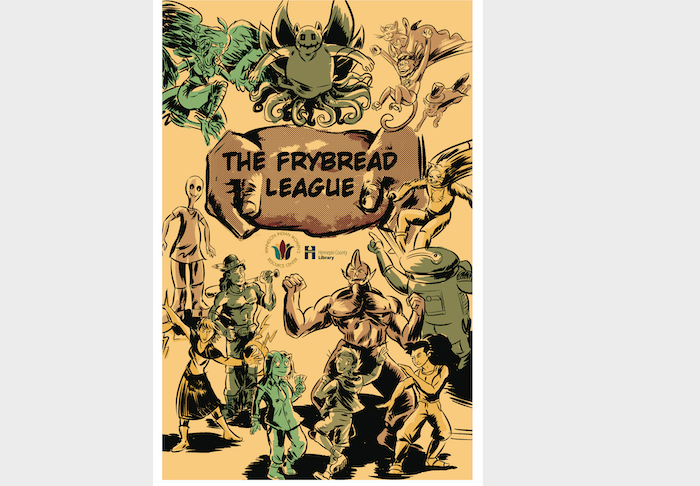
The Minnesota Indian Womens’ Resource Center recently teamed up with Hennepin County Library to host an Indigenous Comic Book Workshop in Minneapolis. Youth ages 12 and over came together to look at how Natives are portrayed in comic books and to create their own super-human heroes or villains. Reporter Melissa Townsend was at the workshop and has this report.
Transcript
HOST INTRO: The Minnesota Indian Womens’ Resource Center recently teamed up with Hennepin County Library to host an Indigenous Comic Book Workshop in Minneapolis.
Youth ages 12 and over came together to look at how Natives are portrayed in comic books and to create their own super-human heroes or villains.
Reporter Melissa Townsend was at the workshop and has this report.
A good comic book character is unique, with a dramatic backstory and of course super human powers. So in the opening activity of this comic book writing workshop, all 15 or so youth here created their hero.
They named it Super Scumbiglio. Its pronouns are they and them. They have the body of a bumble bee, a cube shaped head with eyes on every side. Instead of legs - they have 7 and a half tentacles. Their arms are made of spaghetti and their hands are meatballs. What’s their superpower?
SARAH: Their meatball hands can change into different shapes, they can skip commercials and they have the power to control pasta. (:09)
Sarah Edstrom is a Sexual Assault Advocate at the Minnesota Indian Women’s Resource Center. She’s also co-leading this session. She gives me Super Scumbiglio’s backstory.
SARAH: We asked the origin story and they said - this character had really terrible health insurance. so they were attacked by a shark and when they went for surgery, their insurance would only cover them being remade with parts left over from other surgeries. So… (:20)
Sarah tells me this is a great example of how a lot of comic book stories deal with social and political issues.
SARAH: So we talked about characters who have experienced life in foster care, who have experienced physical and sexual abuse.
Sarah wanted to host this comic book workshop at the Minnesota Indian Women’s Resource Center because she wanted to see more Native superheroes.
Jack Kotz is a comics artist and he’s co-facilitating this workshop. He works with a comics collective called WorldMonster HQ. Jack has one goal.
KOTZ: Right now it’s more about how can we actually get more Native people creating and how can we get more Native super-hero teams. (:09)
Lincoln Matt is one of the artists here today.
MATT: I’ve always had this interest in comics ever since middle school. I used to make a lot of strip funnies. My dream is to get into the comic book industry.
Linc is Native but he’s not creating Native characters. He’s working on developing two kung fu characters.
MATT: It’s kind of weird. I want it to be like an homage to a bunch of old Kung Fu movies especially like Drunken Master and Big Trouble in Little China - classic, low budget but still you can see the passion going into that choreography and I want to try and translate that into illustration. (:25)
Gerry Zink is a serious comics fan. He’s 16 and he’s here to participate in the workshop. I sit down next to him in front of 6 piles of his very neatly stacked comic books.
MELISSA ON TAPE: You like reading comics - do you like writing comics as much?
ZINK: No I don’t. Not really. [LAUGHS] I currently have a facebook account where I write film reviews now. (:16)
Gerry and I talk for a while. It’s clear he is really an expert on comic books and movies. He says the best ones are the most complicated and immerse you in a different world.
GERRY: Love it specially when there’s tons of world building and tons of character to it. (:09)
Workshop facilitator Sarah Edstron says that’s what she wants to see in a good comic book character — someone who is complicated like real people….
SARAH: And if we’re looking at people as just their tragedy or just one part of their story, we’re not actually seeing them. Sometimes we’re good guys. Sometimes we’re bad guys. That’s who we all are. Everthing in our live made us who we are but we get to decide what we do with that.
This was the first Indigenous comic book illustration workshop Sarah has organized at the Minnesota Indian Women’s Resource Center. But she says it won’t be the last.
For Minnesota Native News, I’m Melissa Townsend.
Funder Credits
Extra:
SARAH: I didn’t realize we had this many geeks in our community!
MELISSA ON TAPE: Would you call yourself a comic book geek?
SARAH: [laughs] Um, A little bit.