
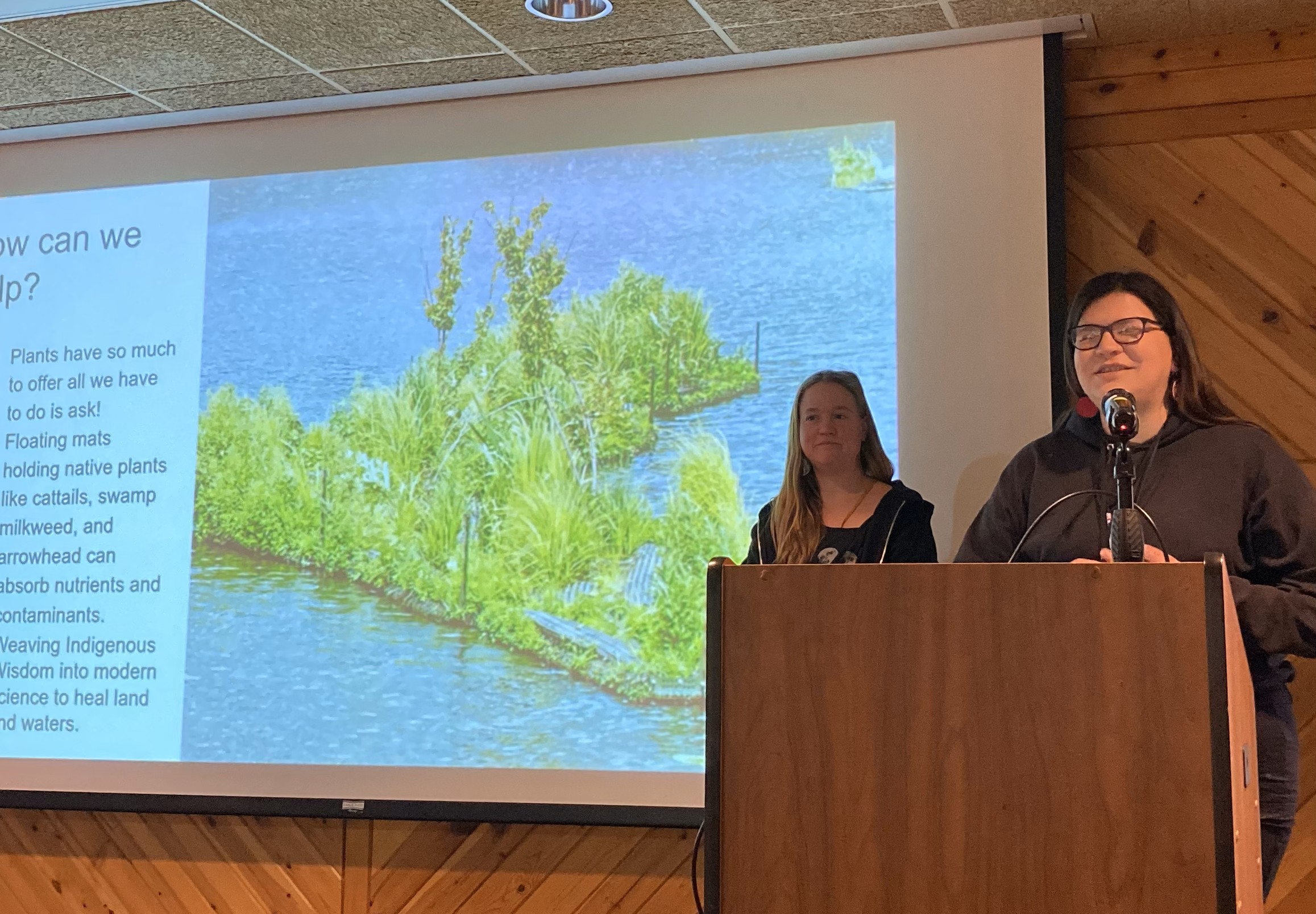
Presented by the White Earth Land Recovery Project, the Great Lakes Indigenous Farming Conference celebrated its 22nd year this March. Deanna StandingCloud speaks with two of the conference participants about their work: Kaylee Carnahan, the Administration Associate and Greenskeeper for the Indigenous Environmental Network, and Leanna Goose, a citizen of the Leech Lake Band of Ojibwe and a Co-Facilitator with the Rise and Repair Coalition.
Transcript
Reporter: Sunlight gently dances across the top of Sugar Lake in Cohasset, Minnesota. It's early March, and spring is in the air, as grassroots organizers, knowledge keepers, farmers, nutritionists, climate change makers and the like gather for the 22nd annual Indigenous Farming Conference. Around 100 people participated in the 2025 Indigenous Farming Conference to share innovative eco strategies, uplifting stories and to celebrate local farmers who help nourish families across Minnesota and the Great Lakes region.
[Sound element: (conference audio), "Minnesota's waters flow outward. No waters flow in."]
Reporter: Workshops offered included topics such as climate as a living process and creating positive change through food. One of the breakout sessions discussed solutions that promote access to clean water by using the natural environment entitled grassroots bioremediation project. Kaylee Carnahan is the administrative associate and Greenskeeper for the Indigenous Environmental Network. She shares a little about the bioremediation project she's working on.
Kaylee Carnahan: Bioremediation has a lot of forms. Three major forms is phytoremediation, is with the plants, and then micro remediation is with the fungi, or the mycelium, the mushrooms. And then micro remediation is with the bacteria, the little the little money, the little spirits.
Reporter: Leanna Goose, a citizen of the Leech Lake Band of Ojibwe, is also a co facilitator with the Rise and Repair Coalition. Much of her work is focused upon ensuring future generations have access to manoomin, or wild rice, a sacred staple regarded by the Anishinaabe people of Minnesota.
Leanna Goose: Minnesota has over 2000 waters that are listed as impaired waters.
Reporter: Leanna and Kaylee co presented the grass roots bio remediation project to conference participants.
Leanna Goose: So a lot of lands and waters within Turtle Island are contaminated. And really wanting to focus in on how humans can help fix that problem. Since we are a part of why our lands are contaminated, it seems, it seems like we can lead the way and help help fix that.
Reporter: Both Leanna and Kaylee are mothers. They believe the decisions that we make about our waters today affect the next seven generations.
Leanna Goose: At a time when my kids are just beginning to get to no wild rice, and I really want to do what I can to help make sure it remains for them. So our existence and manoomins are tied together, as we both depend on clean water for our survival, and I think it's something that resonates with all Minnesotans, is that we all need clean water to survive.
Reporter: Much of the conference highlights protecting the land and shifting the way Minnesotans see the environment around us.
Leanna Goose: We are power, and we can, we can be the change that we want to see in the world. And I think the time that we're living in requires resistance, resistance to these different threats that are coming our way. But it also requires revolution. And I'm not talking about like the revolution where the government is overthrown. I'm talking about like the revolution of where we begin to care for the land beneath our feet and the waters that bring us life. And that's what this project is about.
[Sound element: conference audio: "That Lake turns green in the summer.")
Reporter: Quality farming practices that produce nutritious local food are dependent on clean water, which are some of the conversations happening during the conference. You can find resources and keep up with important legislation on environmental issues at rise and repair.org. Learn more about the teaching garden with the Indigenous Environmental Network at IENearth.org. For North Star stories, I'm Deanna StandingCloud.