
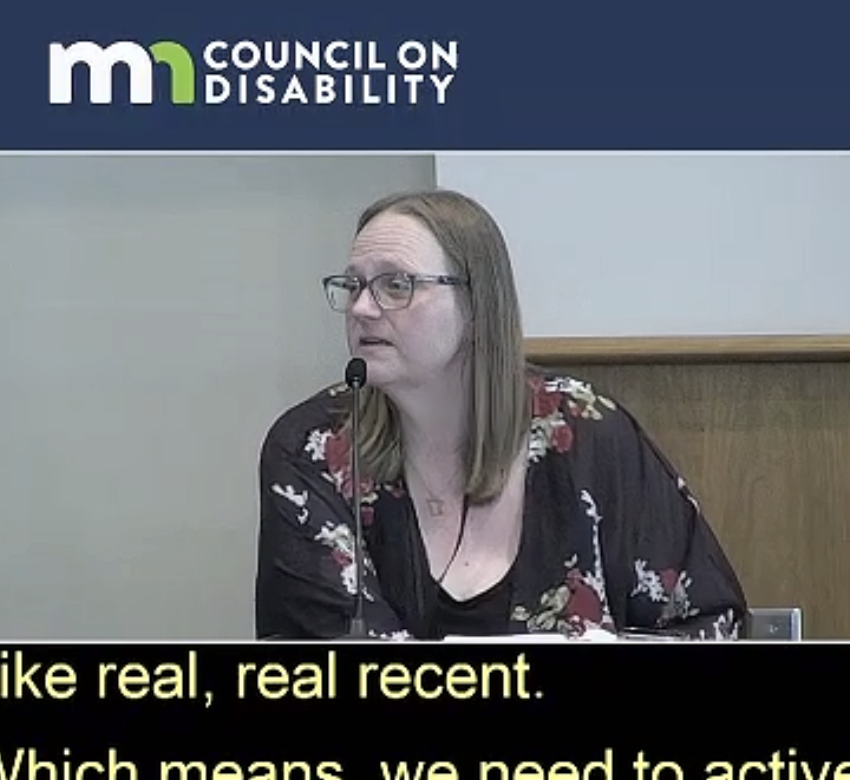
At the 2025 Legislative Forum hosted by the Minnesota Council on Disabilities on March 14, 2025, State Representatives addressed budget cuts affecting the disability community, including the $19 million deficit in Minnesota’s Vocational Rehabilitation Program, which threatens to cut vital support for nearly 14,000 individuals with disabilities. Representatives contend that denying access to employment support could constitute a civil rights violation, challenging harmful stereotypes that label people with disabilities as economic liabilities. Speakers include MN State Representative Democrat Kim Hicks (District 25A), State representative Rep. Brion Curran (District 36B), Rep Peter Fisher (District 44A) and Rep. Katie Jones (District 61A).
Transcript
Representative Kim Hicks: [I] Want to remind everybody that we're really new to having rights. Our existence in society is been real recent, which means we need to actively work to defend the rights we have and advance the process we currently have.
Katy DeCelle: That's Minnesota State Representative Democrat Kim Hicks, who represents District 25A. She's speaking at the Minnesota State Capitol for the 2025 legislative forum hosted by the Minnesota Council on Disabilities. Among many issues discussed by advocates and representatives at the March 14 forum were budget cuts to the state's Vocational Rehabilitation Program. This program provides employment support, like counselors, to individuals with disabilities to help them find and keep employment.
Representative Kim Hicks: In the state of Minnesota, voc rehab is facing a $19 million shortfall that is going to lay off VR counselors. Laying off VR counselors means we're going tostruggle to find work, access to employment as a civil rights issue.
Katy DeCelle: According to recent reporting from the Minnesota Star Tribune, nearly 14,000 Minnesotans with disabilities accessed vocational support last year with these budget cuts, concerns are being raised that clients will not receive the quality of care and support needed and will lose access to basic needs like employment.
Representative Kim Hicks: As a group, we need to stand up and say the fact that we require support does not make us less than and does not make it our fault that there are needs.
Katy DeCelle: Representative Hicks also criticizes the perceptions that individuals with disabilities are often unfairly viewed as a financial burden.
Representative Kim Hicks: The picture that's being painted of our community is that we are a drain on the system. We have heard us be blamed for any financial trouble. It's long-term care, it's special ed, the people with disabilities. That's why we have the deficit.
Katy DeCelle: Representative Hicks emphasizes that funding priorities should focus on supporting those with the greatest needs.
Representative Kim Hicks: Our budgets speak to our values, and our budget should value those with needs. First. We should pay for those needs by making sure that ultra wealthyand wealthy corporations pay their fair share to make sure that everyone gets what they need to continue to live in community.
Katy DeCelle: State Representative Brion Curran from District 36B emphasized the need for Minnesota's budget to reflect the needs and basic civil rights for people with disabilities.
Representative Brion Curran
The disability community is right in the middle of some real civil rights issues. A lot of times it does come down to dollars, it comes down to resources, it comes down to infrastructure. We cannot let the narrative be taken over that our community is expensive, that we don't have the time, that we don't have the money, we don't have the resources, we don't have the infrastructure, andwe are not going to go back when it comes to the rights that people are afforded in this country.
Katy DeCelle: Representative Kim Hicks adds that by not receiving needed services, individuals with disabilities are going back to a time of institutionalization and segregation.
Representative Kim Hicks: If we're forced to not be able to afford our lives because of our needs of service, then we're just institutionalized in a different way. If our kids with disabilities can't go to school and get reasonable accommodations and access to special education support, then what happens is they get put in a school, but they're in a separate classroom, and we have to stop tap dancing around it and say it out loud. The lack of funding for the services and supports that we need, leads to segregation, and we should never sit idly by and allow that to happen again.
Katy DeCelle: Representatives were asked the best way that everyday people could get involved. Representative Peter Fisher from District 44A.
Representative Peter Fisher: We have to start making tough decisions in a couple of months after this session is over, I don't live with the challenges and barriers that you folks do every day, and I need to hear that experience from you folks to be able to reflect, to make sure we get it right for you.
Katy DeCelle: Representative Katie Jones from District 61A.
Representative Katie Jones: Hearing your stories, that is what's motivating. When we can see and hear and feel that there's another human who's experiencing this. We feel it deeply, and it's when we feel that's how we can take the best action.
Katy DeCelle: For North Star stories, I'm Katharine DeCelle.